Faster MSME Sanctions.
Fewer Surprises After Disbursal
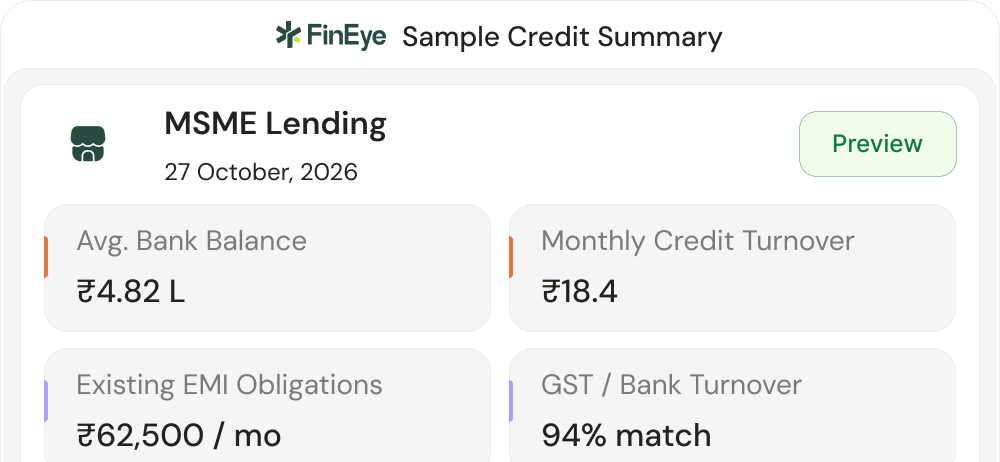
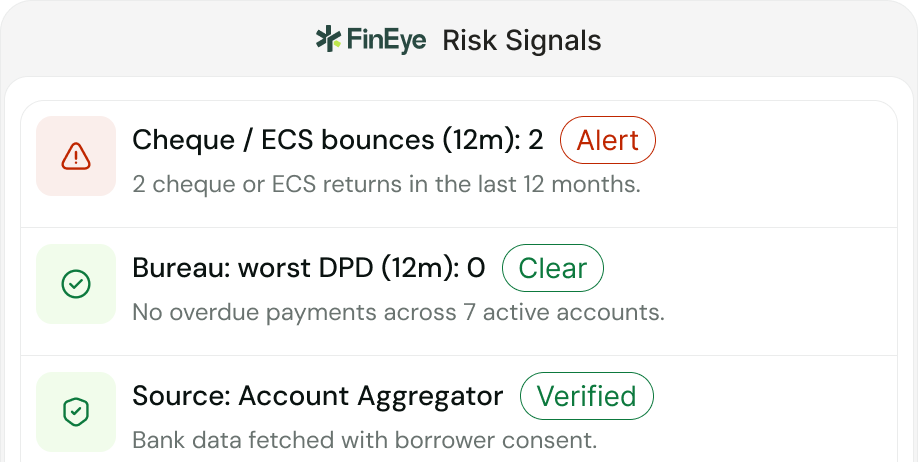
FinEye reads every bank statement, GST return and bureau report that reaches your credit desk, and returns one decision-ready view of the borrower. Your branches work to the same standard, your analysts stop rekeying data, and the warning signs show up before the limit is sanctioned, not after.
Where MSME Lending Slows  Down
MSME files carry the most paperwork and the least certainty. The evidence a credit team needs sits inside bank statements and GST returns, and reading it by hand is what sets the pace.

Every Branch Reads a Statement Differently
One analyst averages six months, another twelve. One counts a bounce, another lets it pass. The same borrower can get two answers from two branches, and neither decision is easy to defend six months later.

Working Capital Files Take the Longest
Sizing a cash credit or overdraft limit means reading a year of statements, matching turnover to GST returns and allowing for seasonality. Done by hand, it takes days per file and is first to queue up at quarter end.

Stress Shows Before it Reaches the Ledger
Falling balances, rising bounces and funds moving to related parties appear in the statement months before an account slips. Nobody re-reads those statements after disbursal, so the signal is lost.
What FinEye Checks on Every Application
Each check runs automatically on every application. The result sits at the top of the report, with the supporting transactions one click away.

Average Bank Balance and Cash-Flow Trend
Whether the account can carry the limit being asked for

Income, EMI Obligations and FOIR Inputs
How much of the borrower’s cash flow is already committed


Cheque and ECS Bounces
Repayment discipline over the last twelve months

Circular and Related-Party Transactions
Whether turnover is real or rotated between linked accounts

GST Turnover Against Bank Credits
Whether declared sales are supported by money actually received


Buyer and Supplier Concentration
How exposed the business is to losing one customer

DPD History and Undeclared Obligations
Loans the borrower is repaying that the application did not mention


Statement Tampering and Missing Pages
Whether the file is genuine and complete before anyone reads it

Average Bank Balance and Cash-Flow Trend
Whether the account can carry the limit being asked for
GST Turnover Against Bank Credits
Whether declared sales are supported by money actually received
Income, EMI Obligations and FOIR Inputs
How much of the borrower’s cash flow is already committed
Buyer and Supplier Concentration
How exposed the business is to losing one customer
Cheque and ECS Bounces
Repayment discipline over the last twelve months
DPD History and Undeclared Obligations
Loans the borrower is repaying that the application did not mention
Circular and Related-Party Transactions
Whether turnover is real or rotated between linked accounts
Statement Tampering and Missing Pages
Whether the file is genuine and complete before anyone reads it
From Application to Annual Review
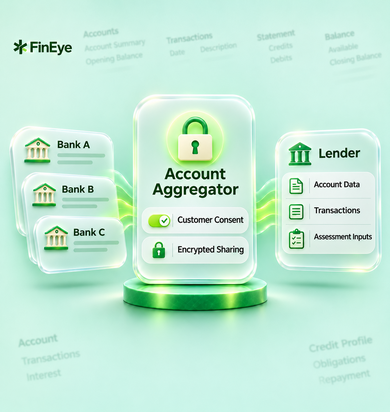
Fetch statements through Account Aggregator consent, or upload PDFs, GST returns and bureau reports.


PreAnalysis screens for tampering, missing pages and period gaps before analysis.

Banking, GST and bureau data are checked together for turnover, obligations and repayment behaviour.

The analyst gets a decision-ready report with every figure traceable to its source.

Re-run analysis at review on fresh, consented data to surface emerging risks.

Six Layers of Protection on Every Loan File
Each product closes a different gap fraudsters use. Together they give your credit team one checked view of every borrower.
Built for How
Banks Lend
From branch-level working capital to central credit and co-lending
portfolios, the same analysis runs on every file.
 MSME / SME Term LoansCash Credit/OverdraftWorking CapitalLoan Against PropertyPriority Sector Lending

One Standard in Every Branch
Central credit sees the same report as the branch.
Working Capital Inputs
Average balances, turnover, seasonality and obligations in one view.
Ready for Co-Lending
Share verified figures with your NBFC partner.
Every Figure Comes With its Evidence
Your credit committee, your auditors and your regulator can all trace a decision back to the transactions it rests on.

Questions
Bank Credit Teams Ask
Reports are ready the same day the statement is uploaded or fetched, and 99% are delivered within the agreed SLA turnaround time. Your credit team can plan to a predictable timeline even when volumes spike at quarter end.
 How quickly do we get a report?

It refers to data-extraction accuracy: 99% of transactions are read with the correct date, amount, balance and description. Every figure in the report links back to the transactions behind it, so an analyst can check any number in seconds rather than taking it on trust.
What does 99% accuracy mean?Yes. Results come back as structured data through the API, so they can flow straight into your LOS and your credit rules. Teams working outside the LOS can download the full report instead.
Can FinEye integrate with our loan origination system?Use Account Aggregator wherever the borrower’s bank supports it. The data comes directly from the bank on the borrower’s consent, so it cannot be edited and it arrives within minutes. Keep PDF upload as the fallback for banks not yet live on the network, or borrowers who prefer to share statements themselves. FinEye analyses both the same way, and uploaded PDFs are checked for tampering first.
Should we use Account Aggregator data or PDF statements?Yes. Bank Statement Analysis flags money that moves out to related accounts and returns, a common way of making a business look larger than it is. GST Analysis then tests declared turnover against both GST returns and the credits that actually landed in the account. Where the three do not agree, the gap is shown
Can FinEye tell real turnover from rotated turnover?Yes. Where the borrower’s Account Aggregator consent is still in place, you can run the same analysis again on fresh data at review. Falling balances, rising bounces and new obligations surface while there is still time to act on them.
Can we use FinEye after disbursal, not just at sanction?FinEye works as a data processor under India’s Digital Personal Data Protection Act, 2023, which means your bank remains the data fiduciary. Borrowers give explicit consent before any data is fetched, every consent is logged, and consent can be withdrawn as per the guidelines.
How does FinEye handle borrower data and consent?Send us a set of past applications, including files that later turned bad. We will run them through FinEye and show you what the report would have said at the time. It is the quickest way to see how the output fits your credit process.
How can we test FinEye before committing?Further Reading on Lending
Bank Credit Teams
November 4, 2026 · 9 min read
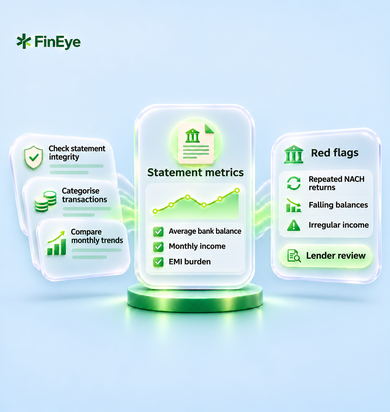
Bank Statement Analysis for Lending: Metrics, Methods, and Red Flags for Indian Lenders

Shivam Jadon
Digital Marketing Associate
November 4, 2026 · 9 min read
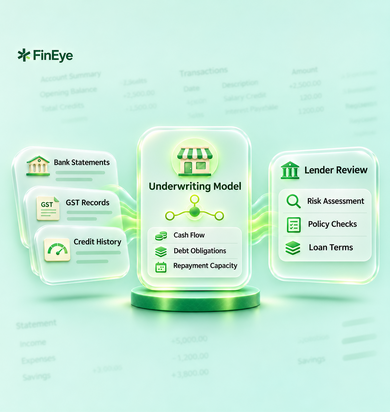
Credit Underwriting for MSME Loans: Process, Models, and the Data Behind Each Decision
Shivam Jadon
Digital Marketing Associate
November 3, 2026 · 12 min read
What is an Account Aggregator for Lenders? Understanding Meaning, Features & Benefits
Shivam Jadon
Digital Marketing Associate
 MSME Lending Intelligence Platform
- +91 96670 90342
- info@fineye.co
- Noida, Uttar Pradesh, 201301
Resources
Blogs
▶

