Account Aggregator vs Bank Statement Upload and What It Means for Loan Underwriting
shivam jadon
Featured
Summary
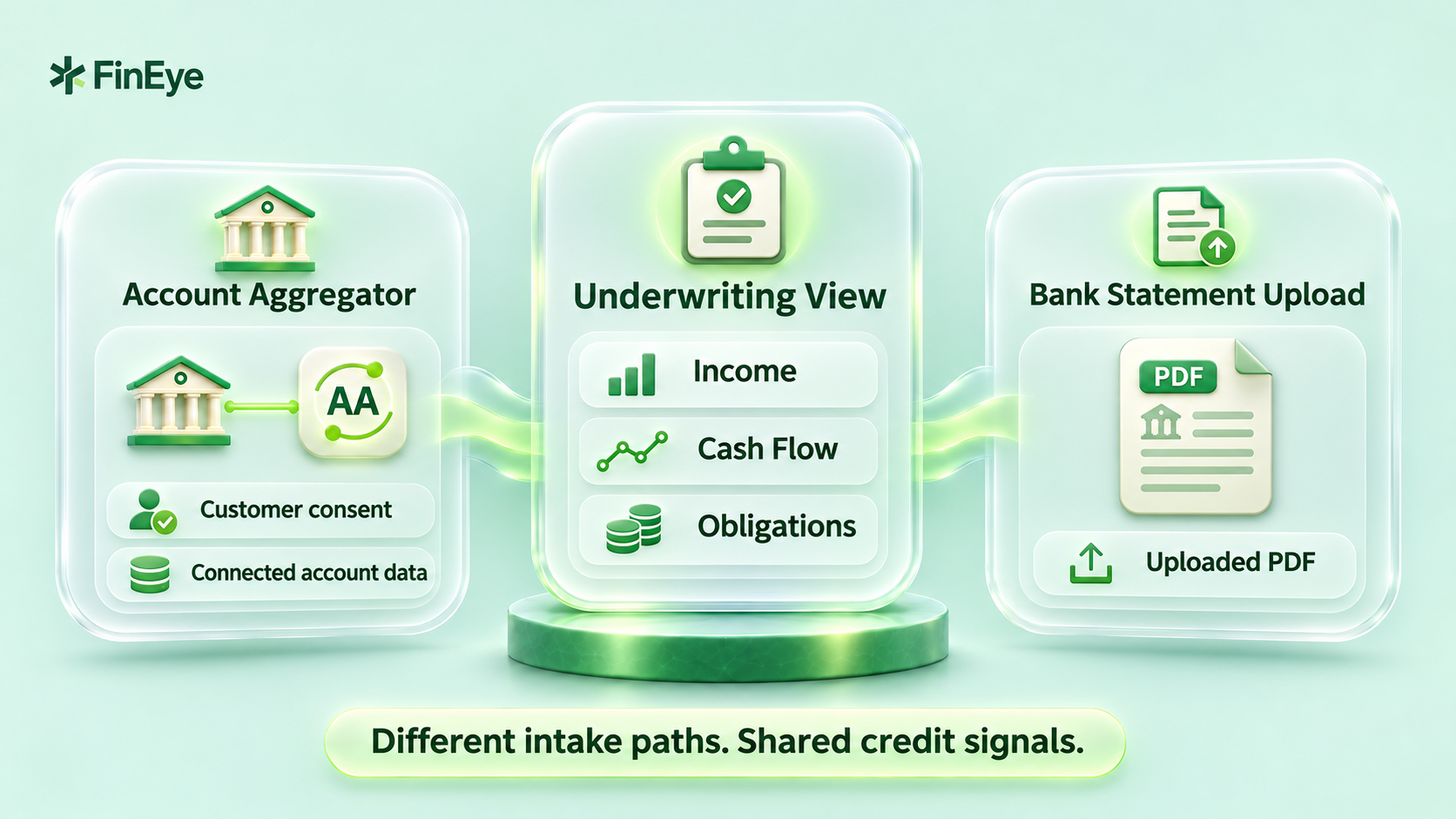
Lenders should use Account Aggregator (AA) as their default source of bank data and accept uploaded bank statements only where AA cannot reach. AA data comes straight from the bank, signed and structured, so it is faster and far harder to fake. Statements still fill real coverage gaps, but they need closer checks.
It is a Monday morning at a mid-size NBFC, and three loan applications land on the credit desk.
Rohit is a software engineer in Bengaluru. His salary goes into a large private bank, and he shares his bank data through an Account Aggregator in about two minutes.
Sunita runs a kirana store in Nashik. She banks with a local cooperative bank, so she sends a photo of a statement printed at her branch.
Farhan has just moved back from Dubai. Part of his income still lands in an account there, so his file arrives in two pieces: some data through AA, some as a PDF.
Same lender, same day, three very different files. So which route should a lender actually trust for cash-flow underwriting? Let us look at both, and then give you a straight answer.
Key Takeaways
The verdict: Account Aggregator first, uploaded statements as the fallback, and the same analysis for both.
Account Aggregator data is digitally signed by the bank, so there is no document for anyone to edit.
Statements are still needed when a borrower’s bank is not on Account Aggregator, when income sits in an overseas account, or when an Account Aggregator fetch fails.
An uploaded statement should be checked for signs of tampering, not just read.
Clean data is only the start. Whichever route it comes from, it still has to be analysed before it becomes a credit decision.
The Short Answer
Lenders should use Account Aggregator for underwriting as the default route for bank data. It is verified at the source, quick for the borrower and ready for analysis. Uploaded bank statements should be the fallback, used only where AA cannot reach, and always checked for tampering. Whichever route the data takes, it should go through the same credit analysis.
What Is Account Aggregator Data?
Account Aggregator data is a borrower’s bank information that travels directly from their bank to the lender, with the borrower’s consent. An RBI-licensed Account Aggregator carries it in between, but cannot read it.
Two things make it different from a document. First, the bank signs the data digitally before sending it, so any change on the way would show. Second, it arrives in a structured format, with each transaction already separated into date, amount, and description.
For Rohit, the whole thing took two minutes. He entered his mobile number, confirmed an OTP, reviewed what the lender was asking for, and tapped approve. He never downloaded a single file.
What Is a Bank Statement Upload?
A copy of the borrower’s bank statement shared with their lender is referred to as a bank statement upload. The bank statement analysis for lending usually comes in one of three forms:
A PDF downloaded from net banking, often password-protected
A scanned or photographed paper statement, printed at a branch
An e-statement emailed by the bank every month
Sunita’s statement is the second kind. It is genuine, but to the lender it is still just a picture of numbers. Someone, or something, has to read it, make sense of it, and confirm it has not been changed.
Account Aggregator vs Bank Statements: A Side-by-Side Comparison
Now, to help understand the differences between Account Aggregator vs bank statements, let us compare them side-by-side:
Parameter
Account Aggregator
Bank Statement Upload
Where the data comes from
Directly from the bank, after consent
From the borrower
Authenticity
Digitally signed by the bank
Must be verified by the lender
Tampering risk
Very low
Real, especially with edited PDFs
Borrower effort
A few taps and an OTP
Find, download, unlock and upload
Data format
Structured and machine-readable
Varies by bank; often needs reading or OCR
Bank coverage
Only banks live on AA
Any bank that issues a statement
Consent record
Built in
Informal
Monitoring after the loan
Possible, with periodic consent
Needs fresh statements each time
Where Account Aggregator Wins?
After we have covered the differences between Account Aggregator and bank statements, let us explore the scenarios where account aggregator for underwriting emerges as a preferred option for lenders:
Data You Can Trust
With Account Aggregators, there is no document in the middle. The data leaves Rohit’s bank, signed, and arrives at the lender exactly as the bank sent it. The credit team does not have to ask “Is this real?” It can go straight to “What does this tell us?”
Less Effort for the Borrower
Rohit did not have to look for his net-banking password, find the right date range, or remember which PDF password his bank uses. One consent flow, and he was done. Fewer steps usually means fewer applicants giving up halfway.
Ready for Analysis From the Start
Because Account Aggregator data is structured, nobody has to retype it or run it through text recognition. Every transaction arrives with its date, amount and description already in place.
A Clean Record of Consent
Every Account Aggregator data pull is tied to a specific consent: what was shared, why, and for how long. If an auditor asks how the lender got Rohit’s data, the answer is already on file.
Monitoring After the Loan
With periodic consent, a lender can keep an eye on the account after disbursal. If Rohit’s salary credits suddenly stop, the lender can find out early, not when an EMI bounces.
Where Bank Statements Still Matter?
If AA is so good, why do lenders still ask for statements? Because an Account Aggregator can only share what it can reach. Here is where it falls short today:
The Borrower’s Bank is not on AA: Many cooperative banks and regional rural banks have not joined the network yet. This is Sunita’s situation.
Income Sits in an Overseas Account: AA works with Indian financial institutions only, so Farhan’s Dubai account is out of reach.
Some Account Types Are Not Supported: Joint accounts, for example, may not be shareable through AA.
The Lender Needs Older History: Some credit policies look further back than an AA fetch can cover.
The AA Fetch Fails: A bank’s systems may be down, or the borrower may drop off before completing consent.
The Borrower is Not Comfortable With It: An unfamiliar consent screen can feel risky to someone who has never used one.
Why Uploaded Bank Statements Need a Closer Look?
Here is the uncomfortable truth about PDFs. They are easy to edit, and edited ones can look perfectly normal at first glance. This makes bank statement fraud detection a bit tricky.
That does not mean most borrowers cheat. Sunita’s statement is entirely genuine. But a lender cannot tell the genuine ones from the altered ones just by looking. So every uploaded statement needs to be checked, not just read.
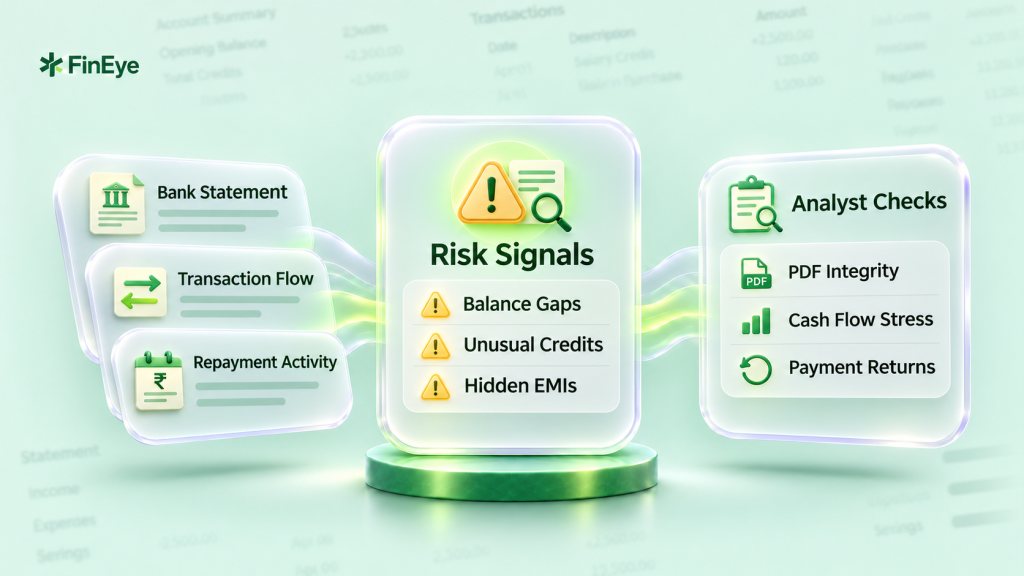
After covering bank statement analysis for lending, let us understand the warning signs credit teams watch for:
Balances that do not add up. Each closing balance should equal the previous balance plus credits minus debits. When it does not, something has been changed.
Missing or shuffled transactions. Gaps in the sequence can hide a bounced EMI or a large payment.
“Salary” that does not behave like salary. A real salary usually arrives from the same employer around the same date each month.
Fonts or layouts that change partway through. Genuine bank statements are consistent from the first page to the last.
Transactions on bank holidays. Some transfers simply cannot happen on those days.
Take a simple example. Suppose two bounced EMIs were quietly deleted from a statement like Sunita’s. The page would still look clean. But a few rows later, the running balance would stop matching the transactions above it, and a careful check would catch it.
This is the core difference between the two routes. AA removes the risk at the source. With PDFs, the lender has to catch it after the fact.
Which Should Lenders Use? The Verdict
As a lender, you should use Account Aggregator wherever it is available and bank statements only where it is not.
That is not a both are equally good answer. AA is the better source of bank data on almost every count that matters for underwriting. Statements earn their place only because AA cannot reach every borrower yet. Here is how that plays out in practice:
Scenario
Use
Why
Salaried borrower whose bank is on AA (Rohit)
Account Aggregator
Verified, fast and structured
MSME borrower whose bank is on AA
Account Aggregator, plus GST data
Real cash flow, cross-checked against declared sales
Borrower whose bank is not on AA (Sunita)
Bank statement, with tampering checks
The only route available
AA fetch fails
Retry through another AA, then a statement
Keeps the application moving
Income in an overseas account (Farhan)
AA for Indian accounts, statements for the rest
Covers the full income picture
Monitoring after disbursal
Account Aggregator
Periodic consent makes regular checks easy
How to Set Up a Dual-Route Underwriting Flow
If you are building or fixing a loan journey, here is a simple way to put the verdict into practice:
Offer Account Aggregator First: Make it the default option, not a hidden alternative.
Check the Bank Before You Redirect: If the borrower’s bank is not live on AA, skip straight to upload instead of sending them into a dead end.
Keep More Than One AA Route: If one AA has trouble reaching a bank, another may not.
Fall Back to Upload Automatically: When a fetch fails, offer the statement option right there, so the borrower does not have to start over.
Check Every PDF for Tampering: Do this for every upload, not just the ones that feel suspicious.
Convert Both Routes Into One Format: Your credit team should see the same view of transactions, whatever the source.
Apply the Same Credit Rules to Both: A borrower should not get an easier or harder decision just because of how they shared their data.
Why the Data Source Is Only Half the Job
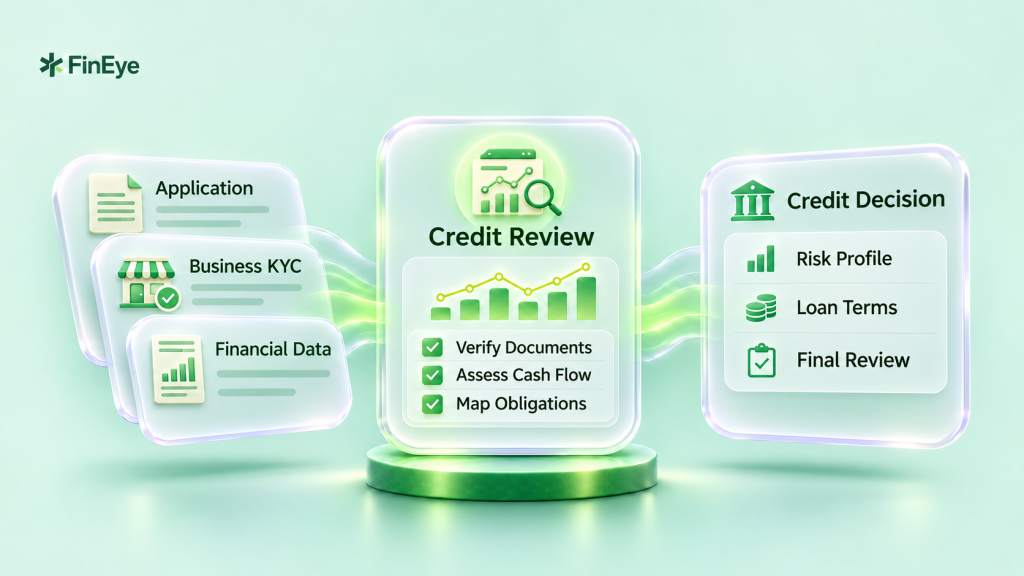
Getting the data in is one thing. Understanding it is another. AA gives you clean data and bank statements give you reach. But neither one tells you whether Rohit, Sunita or Farhan can actually repay. Someone still has to sort a year of transactions into income, EMIs, supplier payments and personal spending, then spot what looks out of place.
That is the job FinEye’s Bank Statement Analyser is built for. It works with both AA data and PDF statements, so every file, whichever route it took, ends up with the same quality of assessment.
Conclusion
Back to that Monday morning. Rohit’s file was the quickest: his data arrived through AA, already verified and ready to read. Sunita’s took a little longer, because her photographed statement had to be checked before anyone could trust it. Farhan’s was built from both routes, AA for his Indian account and a PDF for the one in Dubai.
Three borrowers, three routes, one lender and nd one clear lesson. Account Aggregator should be the first choice for bank data, every time it is available. However, there are still a few account aggregator limitations, and this is why bank statements still matter, but as the fallback, not the default. This is why it is important to understand the differences between Account Aggregator vs bank statements. And whichever way the data arrives, what really decides the loan is how well it is analysed, which is where tools like FinEye make the difference.
Frequently Asked Questions
Is Account Aggregator data better than bank statements for underwriting?
In most cases, yes. AA data comes directly from the bank, digitally signed and in a structured format, so it is harder to fake and quicker to analyse. Bank statements are still useful when a borrower’s bank is not on AA, but they need extra checks.
Can Account Aggregator data be tampered with?
Not without it showing. The bank signs the data digitally before it is shared, and the Account Aggregator only passes it along in encrypted form. Any change on the way would break the signature, so the lender would know the data had been altered.
Why do lenders still accept PDF bank statements?
Because Account Aggregator does not cover every borrower yet. Some banks, especially smaller cooperative and rural banks, are not on the network. Overseas accounts are outside it, and AA fetches sometimes fail. Statements keep these applications moving.
What should a lender do if a borrower’s bank is not on Account Aggregator?
Accept an uploaded bank statement instead, and check it for signs of tampering before using it. Ideally, the loan journey should spot this early and offer the upload option straight away, rather than sending the borrower into a consent flow that cannot work.
How can lenders spot a fake or edited bank statement?
Check whether running balances add up row by row, look for missing or out-of-order transactions, and confirm that salary credits follow a regular pattern. Changes in fonts or layout, and transactions dated on bank holidays, are also warning signs. Automated tools can run these checks on every file.
Does Account Aggregator give lenders more history than a bank statement?
Not necessarily. AA can share the period the borrower consents to, but how far back it can go depends on the bank and the request. If a lender needs a longer history than AA can provide, an older statement may still be needed.
Should AA data and PDF statements go through the same credit checks?
Yes. Once both are converted into the same format, they should be judged by the same credit rules. The only difference is that PDF statements need an extra tampering check first, since they did not come straight from the bank.





 November 10, 2026
 12 min read