12 Bank Statement Red Flags Every Credit Analyst Should Know
shivam jadon
Featured
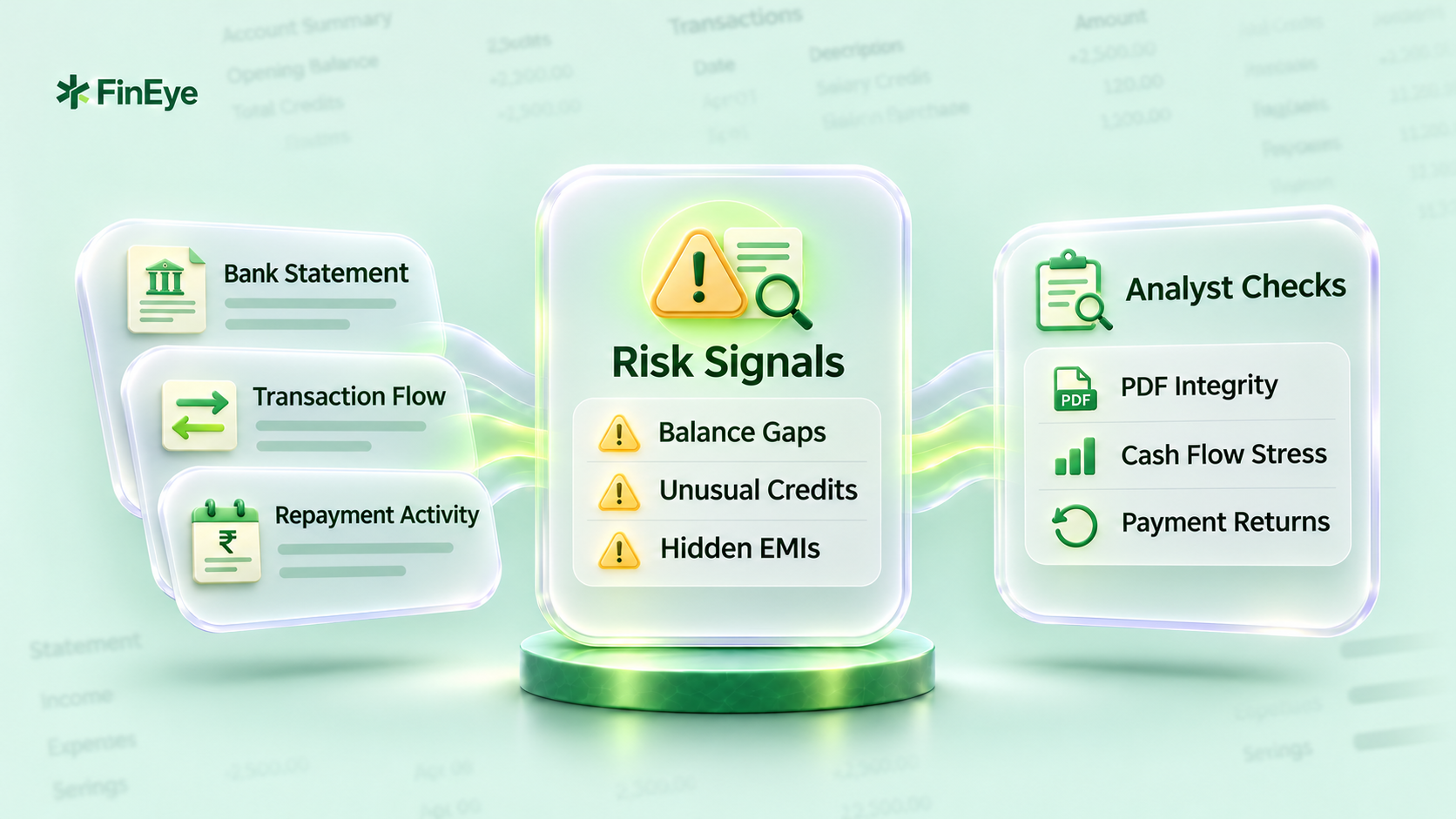
The biggest red flags in a bank statement are EMI and cheque bounces, frequent negative balances, irregular income, hidden loans and unexplained money movements. Each one hints that a borrower may struggle to repay, or that their finances aren’t what they appear to be.
A credit score tells you how someone has repaid in the past. A bank statement tells you what’s happening right now. It shows where the money comes from, where it goes, and whether the borrower is quietly running short every month.
In this blog, we walk through 12 red flags every credit analyst should look for during bank statement analysis. For each one, you’ll see what it looks like on a statement, why it matters, a simple example and what to do next.
Key Takeaways
A bank statement often shows financial stress before the credit report does.
Payment bounces, frequent negative balances, and minimum balance penalties are signs of a borrower running short of money.
Irregular salary, falling balances and loans the borrower didn’t mention can all change how much they can safely borrow.
Large unexplained credits, circular transactions and heavy cash activity can make a borrower look stronger than they are.
A red flag isn’t an automatic rejection. It’s a reason to ask questions, check a longer period or adjust the loan.
Bank statementanalysis with a reliable bank statement analyser makes these red flags faster and easier to spot.
Why Do Red Flags in a Bank Statement Matter?
Credit reports update with a delay, and they only show formal loans. A bank statement shows everything: every EMI, every bounce, every cash withdrawal and every transfer, as it happens.
Here’s a simple example. Rahul has a CIBIL score of 760. On paper, he looks like a safe borrower. But his bank statement shows that two of his EMIs bounced last month, and his account has dipped below zero three times in the last quarter. His score hasn’t caught up yet, but his statement already tells the story. That’s why careful bank statement analysis is one of the most important steps in underwriting.
Meet Our Two Examples
We’ll use two borrowers throughout this guide:
Rahul, a salaried professional earning ₹85,000 a month, applying for a ₹5 lakh personal loan.
Sharma Traders, a small wholesale business applying for a ₹15 lakh working capital loan.
The sample statement lines in this blog are illustrative. Narrations differ from bank to bank, but the patterns are the same.
1. EMI, NACH or ECS Bounces
What it looks like:
05-Aug NACH DR – ABC FINANCE LTD 12,400.00 Dr
05-Aug NACH RTN – ABC FINANCE LTD 12,400.00 Cr
06-Aug NACH RTN CHG + GST 590.00 Dr
An EMI is debited, sent back because there wasn’t enough money, and then a bounce charge follows. This is direct proof that the borrower couldn’t pay an existing loan on time. Many lenders treat repeated EMI bounces as one of the strongest warning signs in a bank statement.
Example: Rahul’s car loan EMI of ₹12,400 bounced in June and again in August. Each time, he paid it a few days later. His credit report may not show it as a serious default, but his statement shows he’s running out of money before his EMIs are due.
What to do: Check how many bounces there are and how recent they are. One bounce a year ago is different from two in the last three months. Ask the borrower to explain, and consider a lower loan amount if the pattern is recent.
When a cheque the borrower issued comes back unpaid, it means the account didn’t have enough money to honour a promise. For businesses, it can also damage relationships with suppliers.
Example: Sharma Traders paid a supplier ₹85,000 by cheque, but it bounced because of insufficient funds. Two months later, another supplier’s cheque bounced. A business that can’t clear its supplier payments is likely to find a new loan EMI hard too.
What to do: Look at the reason for the return. “Funds insufficient” is a serious flag. A signature mismatch or wrong date is usually just a mistake. Also note the difference between cheques the borrower issued (inward returns) and cheques they received that bounced (outward returns). The second points to trouble with their customers, not with them.
3. Frequent Negative Balance or Overdraft Use
What it looks like: The balance column regularly dips below zero, or the borrower is always using the full overdraft limit, with overdraft interest debited every month.
A negative balance means the borrower is spending money they don’t have. If it happens every month, their income isn’t covering their expenses.
Example: Rahul’s account goes into the negative around the 25th of every month and only recovers when his salary arrives on the 1st. That means his ₹85,000 salary is already fully used up. A new ₹11,000 EMI would make the gap even bigger.
What to do: Count how many days a month the account is negative and whether it’s getting worse. For businesses with an overdraft or cash credit account, check whether the limit is always fully used, which suggests they’re stretched.
4. Minimum Balance Penalty Charges
What it looks like:
01-Oct NON-MAINT OF MIN BAL CHGS + GST 472.00 Dr
A penalty for not keeping the minimum balance means the account is regularly close to empty. One penalty isn’t a big deal. A penalty every month is a sign the borrower has little or no cushion.
Example: Rahul’s statement shows a minimum balance charge in five of the last six months. Even though his salary is decent, he isn’t able to keep even a small amount aside.
What to do: Treat it as supporting evidence. On its own, it’s a mild flag. Alongside bounces or negative balances, it confirms the borrower is under financial pressure.
5. Low or Falling Average Balance
What it looks like: The average monthly balance keeps shrinking over several months.
Month
Average Balance
April
₹62,000
May
₹48,000
June
₹35,000
July
₹26,000
August
₹18,000
September
₹12,000
A falling balance means money is going out faster than it comes in. It’s an early warning, often months before any bounce shows up.
Example: Sharma Traders’ average balance dropped from ₹62,000 to ₹12,000 in six months, even though monthly sales looked stable. A closer look showed rising payments to suppliers and a new loan EMI. The business is slowly running out of breathing room.
What to do: Look at the trend, not just one month. For business loans, many lenders also compare the average balance with the proposed EMI to judge how comfortably the business can pay.
6. Irregular, Delayed or Falling Salary
What it looks like:
01-Jun NEFT CR – XYZ TECHNOLOGIES SALARY 85,000.00 Cr
09-Jul NEFT CR – XYZ TECHNOLOGIES SALARY 85,000.00 Cr
17-Aug NEFT CR – XYZ TECHNOLOGIES SALARY 70,000.00 Cr
For salaried borrowers, a steady salary is the main source of repayment. Delayed or reduced salary can mean the employer is in trouble, the borrower is on notice, or their pay has been cut.
Example: Rahul’s salary used to arrive on the 1st. In the last two months, it arrived on the 9th and then the 17th, and dropped by ₹15,000. His salary slip still says ₹85,000. Either his employer is struggling, or something has changed in his job, and either way, his income isn’t as stable as the slip suggests.
What to do: Compare salary credits with the salary slip for the amount, employer name and date. Also watch for a change in employer name, which could mean a job change during the loan process. Use the actual credited amount, not the slip, when calculating FOIR.
7. EMIs or Loans the Borrower Didn’t Mention
What it looks like:
05-Jun NACH DR – PQR FINANCE PVT LTD 9,500.00 Dr
05-Jul NACH DR – PQR FINANCE PVT LTD 9,500.00 Dr
05-Aug NACH DR – PQR FINANCE PVT LTD 9,500.00 Dr
The same amount goes to a lender on the same date every month. Borrowers don’t always declare every loan, especially small ones, loans from family, or informal loans. If you miss an EMI, you overestimate how much the borrower can afford.
Example: Rahul’s application lists only his car loan EMI of ₹12,400. With the new personal loan EMI of about ₹11,000, his FOIR looks like a comfortable 28%. But his statement also shows a ₹9,500 debit to a finance company on the 5th of every month, a second loan he didn’t mention. Adding it pushes his FOIR to about 39%, and that changes how much he can safely borrow.
What to do: Match every recurring debit with the loan application and the credit report. Look for regular payments to individuals too, which could be informal loans. Ask the borrower about any obligation you can’t explain.
8. Many Small Loans from Digital Lenders
What it looks like: Several small credits from different lending companies or apps within a short time, each followed by repayments a few weeks later.
03-Jul IMPS CR – LENDER A LOAN DISB 15,000.00 Cr
11-Jul IMPS CR – LENDER B LOAN DISB 10,000.00 Cr
24-Jul IMPS CR – LENDER C LOAN DISB 20,000.00 Cr
Taking many small loans at once, often called loan stacking, usually means the borrower is borrowing from one place to repay another. It’s a classic sign of a debt cycle.
Example: In three months, Rahul received six small loans of ₹10,000–₹20,000 from different lenders. Most of them were repaid within a month, often using money from the next loan. On the surface, he’s repaying everything on time. Underneath, he’s relying on new loans to stay afloat.
What to do: Count how many different lenders appear in the last six months. Check whether repayments are funded by salary or by fresh loans. Many short-term loans in a short period should prompt a much closer review.
9. Large Unexplained Credits Just Before Applying
What it looks like:
18-Oct IMPS CR – SURESH KUMAR 4,00,000.00 Cr
A big credit from an individual, with no link to salary or business, shortly before the loan application. This is often called window dressing. Money is borrowed from a friend or relative and parked in the account to make the balance look healthy. Once the loan is approved, it goes back.
Example: A week before applying, Sharma Traders’ account received ₹4 lakh from an individual. The closing balance jumped from ₹1.2 lakh to ₹5.2 lakh, which made the business look much stronger. But the money had nothing to do with sales, and there was no explanation for it.
What to do: Ask for the source of any large credit that isn’t salary or business income. Calculate average balances both with and without it. If possible, check a longer period or a more recent statement to see whether the money stayed.
The same amount goes out to a party and comes back from the same party within a few days. Round-tripping makes an account look busier, and a business look bigger than it really is. It’s often used to inflate turnover before applying for a loan.
Example: Sharma Traders’ statement shows ₹2 lakh going to Mehta Enterprises on Monday and coming back on Thursday. This happens almost every month. When the analyst checks, Mehta Enterprises turns out to be run by the owner’s brother-in-law. About ₹24 lakh of Sharma Traders’ yearly “turnover” is the same money going back and forth.
What to do: Look for matching amounts going out and coming back within a short window, especially with related parties. Remove these from turnover and income calculations. Cross-check business credits with GST returns.
11. Heavy Cash Deposits or Withdrawals
What it looks like: Large or frequent cash deposits and withdrawals, often in round amounts, that don’t match the borrower’s profile.
10-Aug CASH DEPOSIT – BRANCH 1,50,000.00 Cr
11-Aug CASH DEPOSIT – CDM 1,00,000.00 Cr
Cash is hard to trace. Heavy cash activity makes it difficult to verify where income comes from and where money goes. For businesses, cash deposits that don’t match tax filings can also point to unreported income or inflated turnover.
Example: Sharma Traders deposited about ₹9 lakh in cash in one quarter. But its GST returns for the same period show sales of only ₹3 lakh. Either the business is underreporting sales to save tax, or the cash isn’t really business income. Neither is a comfortable position for a lender.
What to do: Compare cash deposits with GST returns and the nature of the business. A grocery shop naturally handles more cash than a software consultant. For salaried borrowers, large cash deposits with no clear source deserve an explanation.
12. Betting or Real-Money Gaming Transactions
What it looks like: Regular UPI payments to betting or online gaming platforms, sometimes followed by small winnings coming back.
Frequent betting shows risky spending habits and can quickly drain a borrower’s income. In India, it matters even more now. The Promotion and Regulation of Online Gaming Act, 2025 banned all online money games, and the ban came into full force on 1 May 2026. So such transactions today may also mean the borrower is using banned or offshore platforms.
Example: Rahul’s statement shows 20–25 UPI payments a month to online gaming and betting platforms, adding up to about ₹18,000, which is over 20% of his salary. Combined with his frequent negative balance, it explains where the money is going.
What to do: Look at how often these transactions happen and how much they add up to compared with income. One or two small payments are different from a regular habit. Treat frequent or large payments as a serious affordability concern.
Bank Statement Red Flags at a Glance
Not every red flag carries the same weight. Here’s a quick guide to how serious each one usually is.
Red flag
Typical Severity
What it usually signals
EMI, NACH or ECS bounces
High
Trouble paying existing loans
Cheque returns (insufficient funds)
High
Cash shortfall, unpaid commitments
Frequent negative balance or overdraft use
High
Spending more than earning
Minimum balance penalties
Low to medium
Little or no financial cushion
Low or falling average balance
Medium
Shrinking repayment capacity
Irregular, delayed or falling salary
High
Unstable income or job change
Undisclosed EMIs or loans
High
Repayment burden underestimated
Many small loans from digital lenders
High
Debt cycle, borrowing to repay
Large unexplained credits before applying
Medium to high
Balance inflated to look stronger
Circular or round-trip transactions
High
Turnover or income inflated
Heavy cash deposits or withdrawals
Context-dependent
Untraceable income or mismatch with tax filings
Betting or real-money gaming transactions
Medium to high
Risky spending, possible use of banned platforms
Using a Bank Statement Analyser to Catch Red Flags Faster
FinEye’s Bank Statement Analyser helps credit teams spot these red flags in minutes instead of hours. It helps lenders:
Flag bounces, returns and penalty charges across the whole statement period.
Identify salary and income credits and show how regular they are.
Pick up recurring EMIs and obligations, including ones the borrower didn’t declare.
Highlight unusual transactions, such as large one-off credits and frequent cash activity.
Flag tampered bank statements before they reach the credit decision.
Work with both Account Aggregator data and PDF statements, so every applicant is reviewed the same way.
For business borrowers, FinEye’sGST Analyser helps compare GST-reported sales with bank credits, which is especially useful for catching red flags like round-tripping and cash mismatches.
Conclusion
A bank statement is one of the most honest documents a lender can see. It shows whether a borrower is managing money well or quietly struggling. The 12 red flags in this blog, from EMI bounces to round-tripping and betting transactions, help credit analysts read that story clearly.
No single red flag should decide a loan on its own. But when you know what to look for, ask the right questions and use a reliable bank statement analyser, you can catch risky applications early and approve good borrowers faster.
Frequently Asked Questions
What are red flags in a bank statement for a loan?
Red flags are signs in a bank statement that suggest a borrower may struggle to repay or that their finances aren’t what they seem. Common ones include EMI and cheque bounces, frequent negative balances, irregular salary, undisclosed loans, large unexplained credits, circular transactions and betting payments.
Does one EMI bounce lead to loan rejection?
Not usually. One bounce can happen because of a technical issue or a bank account change. Lenders look at how many bounces there are, how recent they are and whether there’s a pattern. Repeated recent bounces are a much bigger concern.
How many months of bank statements do lenders check?
Most lenders check the last 6 months for salaried borrowers and 6 to 12 months for businesses, though this varies by lender and loan type.
How do lenders find loans a borrower didn’t disclose?
They look for recurring debits of the same amount on the same date each month, especially to finance companies or individuals, and match them against the loan application and credit report.
Do betting or gaming transactions affect loan approval in India?
They can. Frequent betting shows risky spending, and since India’s ban on online money games came into full force on 1 May 2026, such transactions may also suggest the use of banned or offshore platforms. Lenders weigh how often they happen and how much they add up to.
How does a bank statement analyser help credit analysts?
A bank statement analyser reads the full statement, organises the transactions and flags red flags like bounces, recurring EMIs, unusual credits and tampering. That saves analysts hours and keeps the review consistent across applications.





 November 16, 2026
 15 min read