How to Detect Fake or Tampered Bank Statements: The Complete Guide for Bank Statement Analysis
shivam jadon
Featured
To detect a fake or tampered bank statement, check four things: how the statement looks, whether the numbers add up, whether the transactions make sense, and whether the file itself has been edited. The most reliable fix is to get the data straight from the bank, through anAccount Aggregator or direct verification, instead of relying on a PDF the borrower uploads.
Bank statements are one of the most important documents in lending. They show what a borrower earns, what they spend, and what they already owe. That’s exactly why they’re also one of the most commonly faked.
In this blog, we explain the different types of bank statement fraud, the red flags to look for during bank statement analysis, real cases from India, and how a bank statement analyser helps lenders catch what the human eye misses.
Key Takeaways
Fake bank statements are used to inflate income, hide existing loans or show balances that don’t exist.
Fraud ranges from simple PDF edits to statements created entirely with AI, which can look perfect at first glance.
Good bank statement analysis checks five layers: appearance, maths, transactions, behaviour and the file itself.
A genuine statement can still mislead. Money borrowed and parked in an account just before applying can make a borrower look richer than they are.
Cross-checking with salary slips, GST returns, ITRs and credit reports, and getting data directly from the bank are the strongest defences.
A bank statement analyser makes these checks faster and more consistent, especially when a lender handles hundreds of applications a day.
Why Fake Bank Statements Are a Serious Problem for Lenders?
A bank statement is supposed to be proof. When it’s fake, every decision built on it is wrong: the income, the FOIR, the loan amount and the risk grade.
Here’s a real example. In Mumbai, a woman was arrested for allegedly taking a ₹40 lakh home loan from a public sector bank using fabricated salary slips, a forged company ID card and a fake bank statement from another bank. The statement showed a monthly salary credit of ₹61,625 to make her employment look genuine. On paper, everything matched. In reality, none of it was true.
Cases like this show why bank statement analysis can’t stop at reading the closing balance. Fake statements lead to:
Loans to borrowers who can’t repay, which turn into bad loans.
Wrong credit decisions, because income and obligations are misstated.
Regulatory and reputational risk for the lender.
Higher costs for genuine borrowers, as lenders add extra checks and price in fraud losses.
Types of Bank Statement Fraud
Not every fake bank statement is made the same way. To understand how to verify a bank statement, you should know the types of bank statement fraud:
Type of Fraud
What Happens
What It Usually Hides
Edited genuine statement
A real PDF is opened in an editor, and a few numbers are changed
Lower income, overdrafts, bounced EMIs
Fully fabricated statement
A statement is made from scratch for an account that may not even exist
Everything; the borrower’s real finances are unknown
Template-based statement
A bank’s layout is copied and filled with made-up transactions
Real income and obligations
AI-generated statement
A complete statement is generated with AI, with realistic fonts and balances that add up
Real income and obligations
Page swap
A good page from one month replaces a bad page from another
A bad month, such as missed EMIs
Window-dressed genuine statement
The statement is real, but money is borrowed and parked just before applying
The borrower’s actual saving capacity
Someone else’s statement
A real statement belonging to another person is submitted
The applicant’s real finances
Tampering has also become harder to spot over time. Early fakes were simple edits with visible mistakes, like a misaligned number or a font that didn’t match. Today, AI-generated statements can have the right fonts, clean file properties and balances that reconcile perfectly. That’s why modern bank statement analysis has to go beyond looking at the document.
When the Statement Is Real but the Story Is Fake
This type deserves special attention because it fools even careful reviewers. In one US visa fraud case, an applicant showed bank balances of ₹45 lakh and ₹50 lakh in two accounts. Later, he disclosed that his family had taken short-term loans from private sources to inflate the balances just before printing the statements. The statements themselves were genuine. The picture they painted wasn’t.
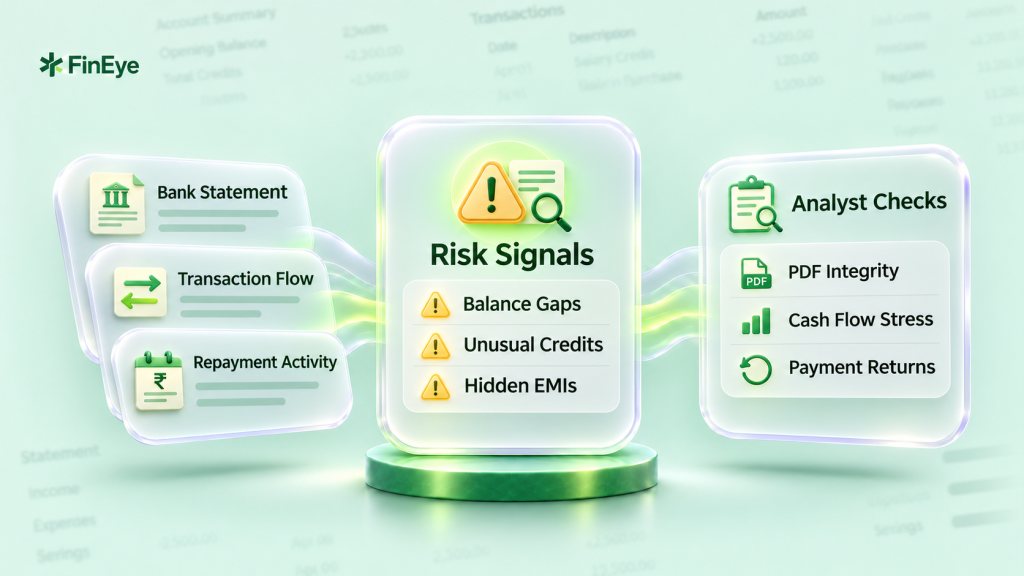
The same trick appears in lending. For example, a borrower’s statement might end with a healthy ₹6 lakh balance. But a closer look shows that ₹5 lakh of it arrived from an unknown individual just three days before the statement was downloaded, with no link to the borrower’s salary or business. The closing balance looks great, but most of that money was never really theirs. Only transaction-level bank statement analysis can catch this.
Red Flags to Check During Bank Statement Analysis
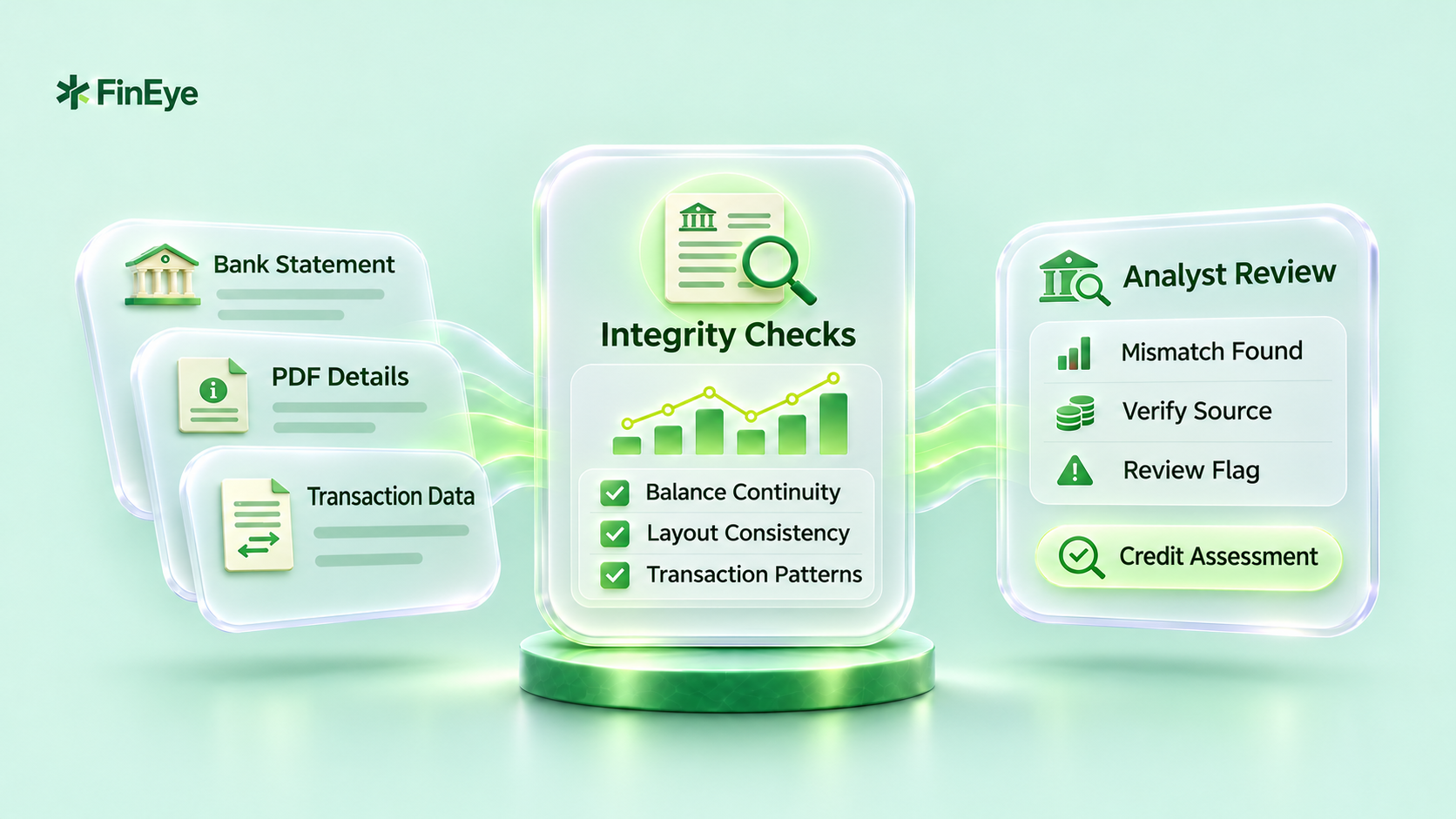
The best way to analyse a bank statement for fraud is to check it in layers. Each layer catches something the others might miss. To understand how to detect fake bank statements, let’s follow one example through all of them.
Rahul, a salaried professional, applies for a ₹6 lakh personal loan. He uploads a 6-month PDF bank statement and a salary slip showing a net salary of ₹85,000.
Layer 1: How the Statement Looks
Start with the basics. Compare the statement with a genuine one from the same bank:
Fonts that change size or style within a line, especially in amounts or dates
Numbers that are slightly out of line with the rest of the column
A blurry or stretched bank logo
Missing details that the bank normally prints, such as the branch address, IFSC code or customer ID
A layout that doesn’t match the bank’s current statement format
Example: In Rahul’s statement, the salary credits use a slightly bolder font than the other entries. That’s a small detail, but it’s often the first sign that a number was typed over.
Layer 2: Whether the Numbers Add Up
This is the simplest and most powerful check. A real bank statement is mathematically perfect:
Running Balance: Every line should follow previous balance + credit − debit = new balance.
Month to Month: Each month’s opening balance should match the previous month’s closing balance.
Totals: If the statement shows total credits and debits, they should match the sum of the transactions.
Example: Rahul’s statement shows an opening balance of ₹42,300 on 1 March, a salary credit of ₹85,000 and debits of ₹18,450. The next balance should be ₹1,08,850, but the statement shows ₹1,28,850. A ₹20,000 gap means a number was changed somewhere.
Layer 3: Whether the Transactions Make Sense
Now look at the transactions themselves.
Salary Credits: The amount should match the salary slip, come from the employer named on the slip, and arrive around the same date each month.
Round Numbers: Genuine salaries are rarely perfectly round. Credits like exactly ₹1,00,000 every month deserve a second look.
Narrations and Reference Numbers: UPI, NEFT and IMPS entries follow set formats. Missing reference numbers, repeated reference numbers or narrations that read oddly are warning signs.
Missing Everyday Activity: A real account usually shows UPI payments, bill payments, ATM withdrawals and other small transactions. A statement with only salary credits and almost no spending looks staged.
Example: Rahul’s salary slip says ₹85,000 from a named company, but his statement shows monthly credits of ₹1,10,000 labelled only as “SALARY”, with no employer name. The mismatch needs explaining.
Layer 4: Behaviour and Patterns
This layer looks at how money moves over time, and it’s the one that catches genuine-but-misleading statements:
Sudden large credits just before the application, especially from individuals
Circular transactions, where money goes out and comes back from the same people
Cash deposits that suddenly increase before applying
EMIs or bounced payments that appear in one month but vanish in others, which can suggest a page was swapped
Spending that doesn’t fit the income, like a ₹2 lakh monthly salary with almost no expenses
Layer 5: The File Itself
Every PDF carries hidden details in its properties, called metadata. You can see them by opening the file’s Document Properties:
Creator or Producer: Genuine statements are usually generated by the bank’s own systems. If the file shows a photo editor, a design tool or a word processor, be careful.
Dates: A modified date that’s later than the created date suggests the file was edited after it was generated.
Scanned Copies: A statement that’s a scan or photo of a printout is harder to verify and easier to fake.
Keep in mind that metadata can be cleaned or faked too, especially in AI-generated statements. That’s why no single layer is enough on its own.
Cross-Check the Bank Statement with Other Documents
A fake bank statement rarely travels alone. Fraudsters often submit a full set of matching fake documents. But it’s hard to make every document agree with every other one, so cross-checking is one of the most effective steps in bank statement analysis.
Compare the Bank Statement With
What Should Match
Salary slip
Net salary amount, employer name and credit date
ITR/Form 16
Annual income should roughly match yearly credits
GST Returns (for businesses)
Reported turnover should broadly match business credits
Credit Bureau Report
EMIs listed in the report should appear as debits in the statement
Loan Application
Declared income, employer and existing loans
Verify at the Source
The most reliable way to beat a fake bank statement is to not depend on the PDF at all. For lenders, there are a few ways to verify at the source:
Account Aggregator (AA): With the borrower’s consent, the data comes directly from the bank to the lender in a standard digital format. There’s no PDF in between to edit.
Net Banking-based Fetch: The borrower logs in, and the statement is fetched from the bank’s site, though AA is the more secure, consent-based route.
Bank Verification: Confirming the account holder’s name and account details with the bank directly.
AA coverage is also set to improve. RBI has said Account Aggregators will become interoperable by 31 December 2026, so a borrower will be able to share data from any bank through any AA. That means fewer applicants will have to fall back on PDF uploads.
Still, PDFs won’t disappear completely. Some borrowers will prefer them, and some banks or accounts won’t be available through AA. So lenders need to be good at analysing both.
An experienced credit officer can catch a lot. But manual review has limits, especially with the newer generation of fakes.
Manual Bank Statement Analysis
Automated Bank Statement Analysis
Speed
Slow, especially for 6–12 months of statements
Results in minutes
Balance checks
Easy to miss one wrong line out of hundreds
Every line checked
Pattern detection
Hard to spot trends across months
Patterns flagged automatically
Consistency
Depends on the reviewer
Same checks for every application
Scale
Struggles with high volumes
Handles thousands of statements
Judgement
Strong at reading context
Best used alongside human review
Bank Statement Analysis Checklist for Underwriters
Use this quick checklist every time you review a bank statement:
Check
What to Look For
Red Flag
Appearance
Fonts, alignment, logo, bank details, layout
Mismatched fonts or a layout that doesn’t match the bank’s format
Running balance
Previous balance + credit − debit = new balance
Any line that doesn’t add up
Month-to-month balance
Opening balance = previous closing balance
A gap between months
Salary credits
Amount, employer name and date
Doesn’t match the salary slip, or no employer name
Narrations and references
UPI, NEFT and IMPS formats
Missing or repeated reference numbers
Everyday activity
Regular spending, bills and UPI payments
Almost no spending at all
Large credits
Source and timing
Big credits from individuals just before applying
Obligations
EMIs from the credit report appear as debits
Known EMIs missing from the statement
Business data
GST turnover vs business credits
Large mismatch
File properties
Creator software and dates
Editing software or a later modified date
Source
AA data or direct bank verification
Borrower refuses to share data through AA without a clear reason
How a Bank Statement Analyser Helps Lenders?
Running every check above by hand on 6 to 12 months of statements, for hundreds of applications a day, isn’t realistic. That’s where a bank statement analyser comes in.
A bank statement analyser reads the statement, organises every transaction, and turns it into insights an underwriter can act on. Instead of scrolling through pages of entries, the credit team gets a clear view of income, obligations and unusual activity.
Flag tampered bank statements, highlighting statements that show signs of editing or manipulation, so suspicious files are caught before they reach the credit decision.
Analyse both AA data and PDF statements, so every applicant gets the same quality of review, whichever way their data arrives.
Identify income credits, including salary patterns, to check them against what the borrower has declared.
Spot recurring EMIs and obligations, including ones the borrower may not have mentioned.
Highlight unusual transactions, like sudden large credits, that need a closer look.
Save underwriters’ time, so they can focus on judgement instead of data entry.
For business borrowers, FinEye’sGST Analyseradds another layer, helping lenders compare reported turnover with what actually flows through the bank account.
Conclusion
Fake and tampered bank statements are getting harder to spot. What used to be a clumsy edit is now often a polished, AI-generated document that looks perfect at first glance. And sometimes, the statement is completely genuine, but the money in it isn’t really the borrower’s.
The answer is careful, layered bank statement analysis: check how the statement looks, whether the numbers add up, whether the transactions and patterns make sense, and whether the file has been edited. Then cross-check it against other documents and, wherever possible, get the data straight from the bank through an Account Aggregator.
A reliable bank statement analyser like FinEye’s Bank Statement Analyser makes this faster and more consistent. It flags tampered statements and turns transactions into clear insights, helping lenders make confident credit decisions without slowing genuine borrowers down.
Frequently Asked Questions
What is bank statement analysis?
Bank statement analysis is the process of reviewing a borrower’s bank statements to understand their income, spending, existing obligations and financial behaviour. Lenders use it to assess repayment capacity and to spot signs of fraud.
What is a bank statement analyser?
A bank statement analyser is a tool that reads bank statements, organises the transactions and turns them into insights, such as monthly income, EMIs, cash flow patterns and unusual activity. It helps lenders review statements faster and more consistently.
How can I tell if a bank statement is fake?
Check whether the fonts and layout match the bank’s format, whether the running balance adds up on every line, whether salary credits match the salary slip, and whether the PDF’s properties show signs of editing. Cross-checking with other documents and verifying with the bank are the most reliable steps.
Can AI detect fake bank statements?
AI-powered tools can check large volumes of statements for mismatched fonts, broken balances, unusual patterns and signs of file editing much faster than manual review. They work best alongside an experienced underwriter.
How do banks and lenders verify bank statements?
Lenders check the statement itself, cross-check it with salary slips, ITRs, GST returns and credit reports, and verify data at the source, through Account Aggregator or by confirming details with the bank directly.
Is submitting a fake bank statement a crime in India?
Yes. Submitting forged documents to obtain a loan can amount to cheating and forgery under Indian criminal law. There have been several arrests in India for using fake bank statements and salary slips to get loans.




 November 13, 2026
 13 min read