What is an Account Aggregator for Lenders? Understanding Meaning, Features & Benefits
shivam jadon
Featured
Ask a credit manager what slows a loan application down, and you’ll rarely hear it is because of the credit score. It is due to bank statements, the PDF that won’t open, the six months that turn out to be four. The statement looks just a little too tidy.
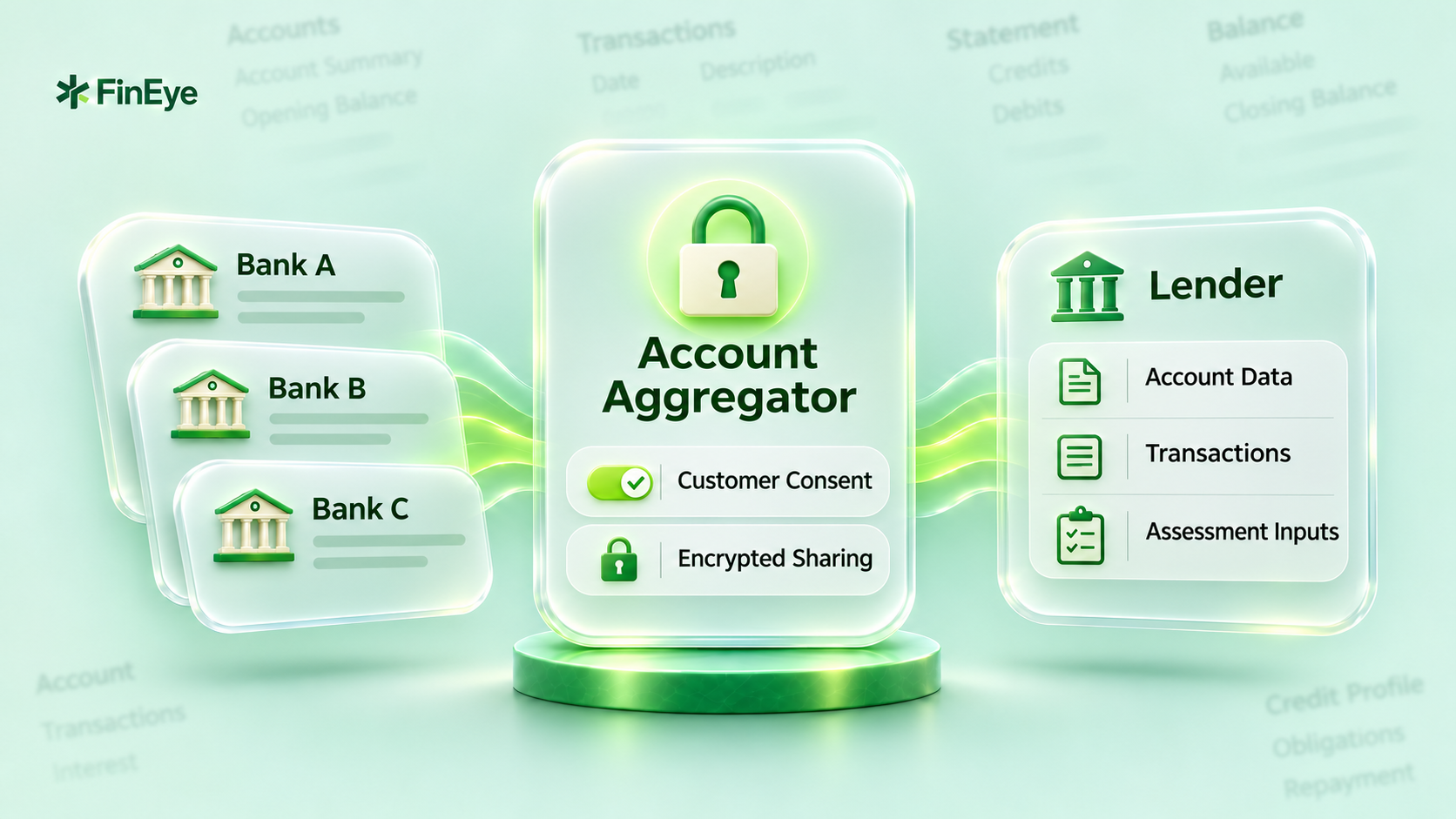
India’s Account Aggregator (AA) framework was built to fix that. Instead of chasing documents, a lender asks for the borrower’s consent and gets the data straight from the source: the bank, the GST network, the mutual fund house. It arrives digitally signed and machine-readable, with no passwords changing hands.
Below, we’ll cover what an Account Aggregator is, how it works from the lender’s side of the table, what data it can deliver, and how it matters to you.
Key Takeaways
An Account Aggregator is an RBI-licensed non-banking financial company (NBFC-AA) that moves a customer’s financial data from the institution holding it to a lender, only with the customer’s explicit consent.
AAs are data-blind. They carry encrypted data but can’t read, store or sell it.
Only entities regulated by RBI, SEBI, IRDAI or PFRDA can request data as Financial Information Users (FIUs).
For lenders, the biggest gain is verified, source-signed data that arrives in minutes rather than after days of document chasing.
What is an Account Aggregator?
An Account Aggregator is an RBI-regulated entity that lets individuals and businesses share their financial data from one regulated institution with another, securely and only with their explicit consent. Legally, it’s a special class of non-banking financial company, licensed as an NBFC-AA.
Think of the Account Aggregator meaning as a consent-driven courier. The borrower decides what goes in the parcel, who receives it, why, and for how long. The Account Aggregator delivers it sealed. It can’t open the parcel, keep a copy, or sell what’s inside.
That also tells you what an Account Aggregator isn’t. It isn’t a credit bureau or a lender. And it isn’t a data warehouse, since nothing stays on its servers once the transfer is done.
Account Aggregator at a Glance
Let us take a quick glance at Account Aggregators for lenders:
Parameter
Details
Entity Type
Non-Banking Financial Company – Account Aggregator (NBFC-AA)
Carrying consented, encrypted financial data from data holders to data users
Consent model
Explicit, purpose-specific, time-bound and revocable
Licensed Account Aggregator
17 (2026)
Industry body and SRO
Sahamati, recognised by RBI as the ecosystem’s Self-Regulatory Organisation in June 2026
Why Was the Account Aggregator Framework Introduced?
Because financial data in India sat in silos, and the workarounds were often worse than the problem.
Before account aggregators, a lender had three ways to see a borrower’s bank history. Ask for a PDF (easy to edit, slow to process). Ask for a physical statement (slower still). Or ask the borrower to type their net-banking password into a third-party screen-scraping tool, which, ideally, nobody should feel comfortable about.
RBI’s answer was a regulated middle layer that moves data with consent, in a standard format, without anyone handling passwords. Here is how it came into formulation:
Date
Milestone
September 2016
RBI notifies the Master Direction for NBFC-AAs
September 2021
The AA network formally launches
June 2026
RBI recognises Sahamati as the Self-Regulatory Organisation for the AA ecosystem
AA is now part of India’s wider digital public infrastructure, sitting alongside rails like Aadhaar and UPI. The idea behind all three is the same: replace paper-based trust with verifiable digital flows.
Who Are the Key Players in the Account Aggregator Ecosystem?
Five parties make the system work. Here is a list of the key players in the account aggregators’ system:
Player
What it does
Examples
Financial Information Provider (FIP)
Holds the customer’s financial data and sends it once consent is given
Collects consent and carries encrypted data from FIP to FIU
The 17 RBI-licensed NBFC-AAs
Customer
Approves, limits or revokes each data request
Salaried individuals, self-employed borrowers, small businesses
Sahamati
Industry alliance and RBI-recognised SRO; maintains the Central Registry of live entities
Sahamati Foundation
How Does an Account Aggregator Work for Lenders?
From the lender’s side, an Account Aggregator journey has six steps. The borrower’s part takes a few minutes; the rest happens between systems. Here is how Account Aggregator works:
The lender raises a consent request. Through its account aggregator, the lender specifies what data it needs, for which period, for what purpose, how often, and for how long the consent should last.
The borrower logs in to the account aggregator, usually with a mobile number and OTP. First-time users create an AA handle, which takes a minute or two.
Accounts are discovered and linked. The Account Aggregator finds the borrower’s accounts at the relevant FIPs, and the borrower confirms each link with an OTP from their bank.
The borrower reviews and approves. Every detail of the request is shown up front. The borrower can approve it or reject it.
The FIP sends the data. The bank or institution prepares the data, signs it digitally and encrypts it before it moves through the account aggregator.
The lender receives and decrypts it. Only the lender can unlock the data. The Account Aggregator passes it along without ever seeing what’s inside.
What Financial Data Can Lenders Access Through an Account Aggregator?
Now, let us cover the types of data that are accessible to lenders through account aggregators:
Data type
Where it comes from
How lenders typically use it
Bank accounts (savings, current, deposits)
Banks
Income, cash flow, existing EMIs, bounces, average balances
GST returns
GST Network (GSTN)
Business turnover and filing discipline for MSME loans
Mutual fund holdings
Asset management companies
Savings habits, asset backing, loans against mutual funds
Equity and demat holdings
Depositories and depository participants
Net worth, loans against securities
Insurance policies
Insurers and insurance repositories
Existing cover and policy details
Pension (NPS)
Central Recordkeeping Agency
A longer-term view of the borrower’s savings
Key Features of an Account Aggregator
Account Aggregators have an array of features from the borrower’s angle. Here’s what each one means when you’re the one receiving the data:
Consent First: No data moves without the borrower’s explicit approval, so every pull has a clean, defensible basis.
Purpose-bound: Data shared for underwriting is meant for underwriting. It isn’t a free pass for cross-selling.
Revocable: Borrowers can withdraw consent at any time, which stops future fetches.
Data-blind Transport: The Account Aggregator carries encrypted data it can’t read, so fewer parties ever see sensitive information.
Signed at the Source: The bank or institution holding the data signs it digitally. Nobody can quietly edit it on the way.
Standardised Format: You get structured, machine-readable data, not a scanned page, so it can feed straight into credit systems.
Auditable: Every consent leaves a record of who asked, for what, and when.
Benefits of Account Aggregators for Lenders
This is where AA earns its place in a lending stack. Not every benefit lands equally for every lender because a gold-loan NBFC and an MSME lender use it very differently, but these are the ones that come up most.
1. Faster Loan Processing
A consent flow takes minutes. Compare that with waiting for a borrower to find, download, and upload six months of statements, then waiting again when two months turn out to be missing. Shorter document collection means quicker decisions. It also means fewer borrowers drifting off to a competitor halfway through an application.
2. Data You Can Trust
A PDF can be edited. AA data can’t, at least not without breaking the source’s digital signature. That changes the question your team starts with. Instead of “Is this statement genuine?”, it becomes “What does this statement tell us?”
3. Lower Cost Per Loan File
Manual statement reading, repeat requests and back-and-forth with borrowers all add up. Structured data removes much of that rework, so credit teams spend their hours on judgment calls rather than data entry. Do factor in fetch charges, though: Account Aggregators may bill lenders per data request, depending on the type of data pulled.
4. Credit for Borrowers With Thin Files
A first-time borrower or a small shop owner may have little or no bureau history. What they do have is a transaction trail. Consented bank and GST datalets lenders look at real cash flow (salary credits, sales inflows, regular outgoings) instead of turning someone away for lack of a score.
5. Better Loan Monitoring
Consent doesn’t have to be one-and-done. With periodic consent, lenders can keep an eye on account health after disbursal and spot stress, such as shrinking balances or missing credits, before an EMI bounces.
6. A Smoother Borrower Experience
No hunting for passwords. No blurry phone scans. No branch visits. For digital lenders especially, fewer steps usually means fewer drop-offs.
7. A Clean Compliance Trail
Every data pull is tied to a specific, recorded consent. When an auditor asks how you got the data and why, the answer is already on file.
Challenges and Limitations Lenders Should Know
Account Aggregator is a big step forward. However, it has its own challenges and limitations:
Fetches Don’t Always Succeed: A request can fail at several points: the borrower drops off, the bank’s systems are down, or the data never arrives. Some industry technology providers have reported AA journey success rates of around 60–65% for individual lenders.
Coverage is Uneven: Not every FIP is live with every AA. A lender connected to a single AA may find some borrowers’ banks out of reach.
Banks Go Offline: Maintenance windows and peak-hour outages at FIPs can break a journey halfway through.
Borrowers Don’t Know What AA is: Many customers have never heard the term. An unfamiliar screen asking for financial data can feel suspicious.
Enabled Isn’t the Same as Linked: As of March 2026, about 284.6 million accounts had been linked against 2.88 billion enabled. Most accounts that could share data through AA haven’t been set up to do so.
Account Aggregator is one of the more tightly fenced corners of Indian finance, and that’s by design. The main rules:
Licensing: An AA needs a Certificate of Registration from RBI under the NBFC-AA Master Direction (2016).
Capital: It must hold a minimum net owned fund of ₹2 crore.
Narrow Scope: An AA can only do account aggregation. It can’t lend, and it can’t use customer data for any other purpose.
No Storage, no Sale: AAs don’t keep or sell the financial information they transfer.
Who Can Receive Data: Only FIUs regulated by RBI, SEBI, IRDAI or PFRDA.
Regulatory Tier: NBFC-AAs always stay in the Base Layer of RBI’s scale-based regulation for NBFCs.
Self-regulation: Since June 2026, Sahamati has served as the RBI-recognised Self-Regulatory Organisation for the ecosystem.
Account Aggregator Adoption in India: Where Things Stand
Five years after launch, AA is well past the pilot stage. Here’s the network by the numbers.
Metric
Figure
Operational Account Aggregators
17
Financial Information Providers live
176
Financial Information Users live
1,076
Accounts enabled for AA
2,880 million+
Consents raised (cumulative)
1,970 million+
Monthly data shares
295 million+
Credit enabled through AA
₹3.82 lakh crore
NBFCs’ share of completed consents
60.08%
Conclusion
An Account Aggregator doesn’t make lending decisions. It makes the data behind them faster to get and much harder to fake. For lenders, that’s a real shift: less time chasing statements, more time understanding the borrower.
It’s also still a work in progress. Fetches fail, coverage has gaps, and plenty of borrowers will keep sending PDFs for a while yet. The lenders who do well with AA treat it as the preferred route, not the only one.
And once the data lands, the harder part begins: reading it accurately and turning it into a sound credit call. That’s where FinEye’s AI-powered financial document analysis comes in.
Turn Financial Data Into Faster Credit Decisions With FinEye
Getting the data is only step one. Someone still has to read it, make sense of it and decide whether the borrower can repay. For most lending teams, that’s where the real time goes: analysts working through page after page of financial documents while applications wait in the queue.
FinEye was built for exactly this stage. It uses AI to analyse financial documents for lenders, so your credit team spends less time on manual review and more time on the calls that actually need human judgement. The result? Shorter turnaround times, fewer files stuck in the pipeline, and decisions your team can stand behind.
If an Account Aggregator has sped up how data reaches your desk, FinEye helps you keep that speed all the way to the decision. Ready to speed up your credit workflow? See FinEye in action.
Frequently Asked Questions
Is Account Aggregator data safe for lenders to use?
Yes. The data is encrypted end-to-end and digitally signed by the institution that holds it. It travels through an RBI-regulated AA that can’t read or store it. Once it reaches the lender, though, keeping it secure is the lender’s job.
Can an Account Aggregator see or store a borrower’s data?
No. An Account Aggregator is data-blind. It passes encrypted data from the provider to the lender without being able to read it, and it’s barred from storing or selling customer financial information.
What’s the difference between an FIP and an FIU?
A Financial Information Provider (FIP) holds the data, like a bank or a GST system. A Financial Information User (FIU) requests and uses it, like a lender or insurer. The Account Aggregator sits between them and carries the data with the customer’s consent.
Do borrowers have to use an Account Aggregator to get a loan?
No. Sharing data through an Account Aggregator is voluntary. Most lenders offer alternatives, such as uploading bank statements, though many borrowers pick AA because it’s quicker.
Can a borrower revoke consent after sharing data?
Yes. Borrowers can revoke consent at any time through their account aggregator, which stops any further data fetches. How long can the lender keep data already shared depends on the data-life terms in the original consent.
How many Account Aggregators are licensed in India?
RBI has granted a Certificate of Registration to 17 Account Aggregators, all of which are operational as of 2026.
What is Sahamati?
Sahamati is the industry alliance for India’s AA ecosystem. RBI recognised it as the ecosystem’s Self-Regulatory Organisation in June 2026. It publishes ecosystem data and standards and maintains the Central Registry of live entities.





 November 3, 2026
 12 min read