







Menu
FOIR, or Fixed Obligation to Income Ratio, is the share of your monthly income that already goes toward fixed payments like loan EMIs and credit card dues. Lenders use it to check whether you can afford one more EMI. The lower your FOIR, the better your chances of getting a loan.
When you apply for a loan, most people worry about their credit score and salary. But there’s a third number that often decides how much you can actually borrow, and that’s FOIR.
In this blog, we explain what FOIR means, how to calculate it with a simple example, what a good FOIR looks like, and how lenders use it while assessing loan applications.
FOIR (Fixed Obligation to Income Ratio) measures how much of your monthly income is already “spoken for” before the month even begins.
Think of your salary as a pie. Every EMI, credit card payment, and other fixed payment takes a slice. FOIR tells you how big those slices are together. If they already take up half the pie, a lender will think twice before adding another slice.
That’s why FOIR matters. It answers one simple question for the lender: after paying your existing EMIs, will you still be able to pay a new one comfortably? FOIR is widely used by banks and NBFCs in India for home loans, personal loans, car loans and loans against property.
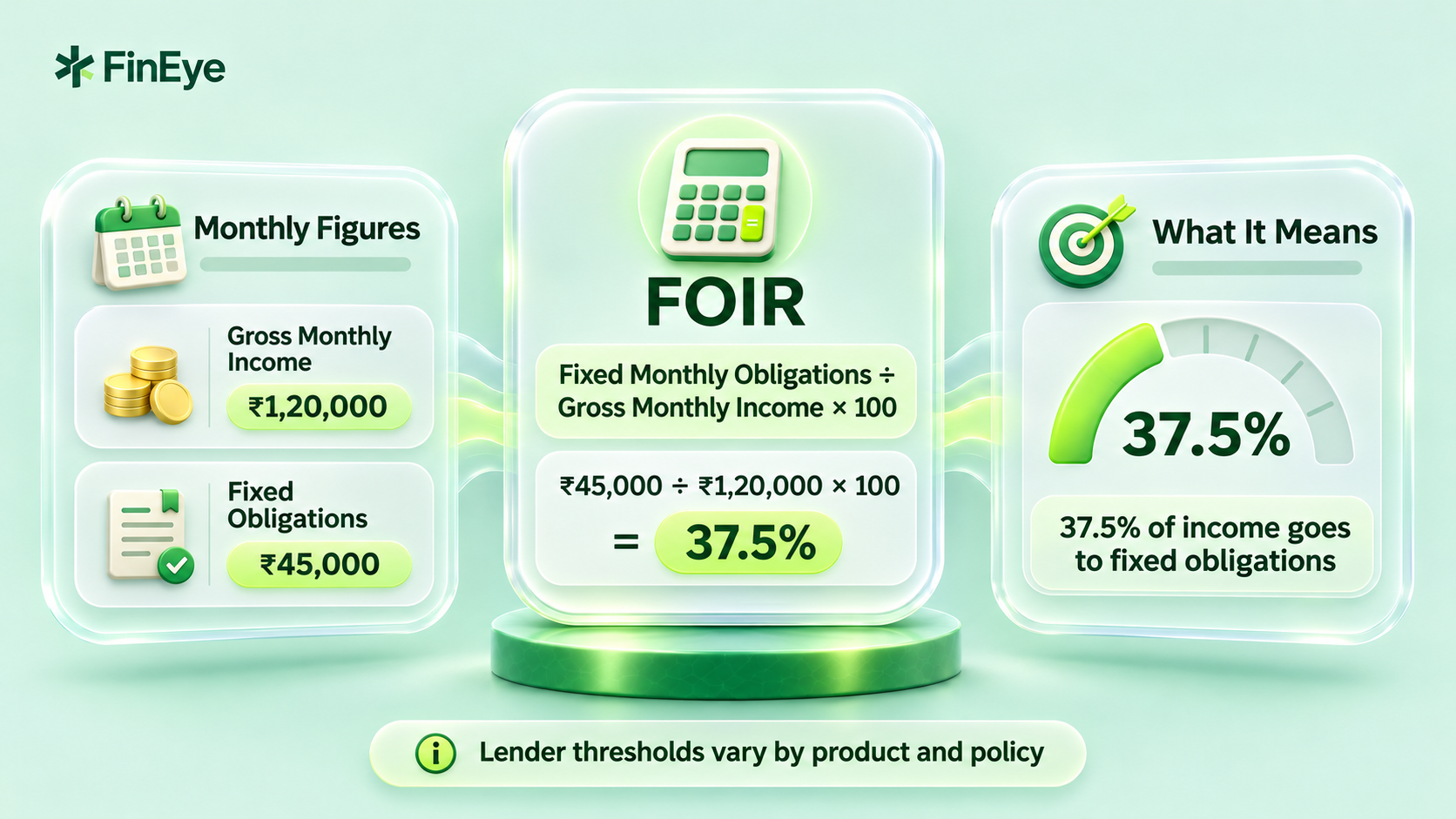
The FOIR formula is simple:
FOIR = Total Monthly Fixed Obligations / Net Monthly Income * 100
Here’s what each part means:
Lenders also flip the formula around to find out how big an EMI you can afford:
Minimum New EMI = (Net Monthly Income * Lender’s FOIR Limit) – Existing Obligations
Not every monthly expense goes into FOIR. Lenders count payments that are fixed and hard to skip.
| Usually Included in FOIR | Usually Not Included in FOIR |
| Home loan EMIs | Groceries and household expenses |
| Car and two-wheeler loan EMIs | Electricity, phone and other utility bills |
| Personal loan EMIs | Fuel and travel costs |
| Education loan EMIs | SIPs, fixed deposits and recurring deposits |
| Credit card dues | Income tax already deducted from salary |
| EMI of the new loan you’re applying for | Shopping and entertainment |
Two items work differently across lenders:
Let’s calculate FOIR step by step with one example. Priya is a salaried professional who wants to buy her first home. Here are her monthly numbers:
| Item | Amount (₹ per month) |
| Net monthly income | 80,000 |
| Car loan EMI | 10,000 |
| Personal loan EMI | 4,000 |
| Credit card dues | 2,000 |
| EMI of the home loan she wants | 20,000 |
First, add up her existing fixed obligations: ₹10,000 + ₹4,000 + ₹2,000 = ₹16,000
Now apply the formula: FOIR = (16,000 ÷ 80,000) × 100 = 20%
So 20% of Priya’s income already goes toward fixed payments.
The lender adds the new home loan EMI to her existing obligations: ₹16,000 + ₹20,000 = ₹36,000
FOIR = (36,000 ÷ 80,000) × 100 = 45%
This is the number the lender actually looks at. At 45%, Priya is within the range most lenders accept.
Say Priya’s lender allows a maximum FOIR of 50%. That means her total fixed obligations can go up to: ₹80,000 × 50% = ₹40,000
She already pays ₹16,000, so the most she can take on as a new EMI is: ₹40,000 − ₹16,000 = ₹24,000
At an interest rate of 9% for 20 years, an EMI of ₹24,000 supports a home loan of roughly ₹26.7 lakh. That’s the ceiling on her loan amount, even if her credit score is excellent.
What if Priya closes her personal loan first? Her existing obligations drop to ₹12,000, and her maximum new EMI rises to ₹28,000. That supports a loan of roughly ₹31 lakh, about ₹4.4 lakh more, just by clearing a small loan before applying.
A FOIR below 40% is generally seen as healthy, and most lenders accept up to 50–55%. Beyond that, getting a loan becomes harder.
| FOIR Range | What It Signals | What Usually Happens |
| Below 40% | Strong repayment capacity | Higher chances of approval, often on better terms |
| 40%–55% | Manageable obligations | Approval is likely, but the loan amount may be capped |
| Above 55% | Income is stretched | Smaller loan, higher interest rate or rejection |
Keep in mind that these ranges are a general guide, not a rule. RBI doesn’t prescribe a fixed FOIR limit, so each bank and NBFC sets its own. A few things can shift the limit:
The same FOIR can lead to different outcomes depending on the loan. The ideal FOIR for home loan depends on:
For example, a borrower with a 52% FOIR might get a home loan approved but face a lower amount or rejection on a personal loan.
FOIR is often confused with other ratios lenders use. In simple terms, FOIR and DTI look at your income, LTV looks at the asset, and DSCR looks at a business’s earnings. Here’s how they differ:
| Ratio | What It Measures | Formula (simplified) | Where It’s Used |
| FOIR | Share of income going to fixed obligations | Fixed obligations ÷ Net monthly income | Retail loans in India |
| DTI (Debt-to-Income) | Share of income going to debt payments | Monthly debt payments ÷ Gross monthly income | Common internationally, similar idea to FOIR |
| LTV (Loan-to-Value) | How much of an asset’s value is being financed | Loan amount ÷ Property or asset value | Home loans, loans against property, gold loans |
| DSCR (Debt Service Coverage Ratio) | Whether a business earns enough to cover its debt | Net operating income ÷ Total debt payments | Business and MSME loans |
If your FOIR is on the higher side, a few steps can bring it down before you apply:
On paper, FOIR is one division. In real underwriting, the hard part is getting the two numbers right: how much the borrower really earns, and how much they really owe. A FOIR built on wrong inputs can make a risky borrower look safe.
Here’s what lenders need to check.
Doing all of this by hand across hundreds of applications is slow and prone to errors. FinEye’s Bank Statement Analyser helps lenders identify income credits, recurring EMIs and other obligations from bank statements, whether they come through Account Aggregators or as PDF files. For business borrowers, the GST Analyser adds another layer to income checks.
FOIR is one of the simplest numbers in lending, yet it often decides how much a borrower can get. For borrowers, keeping FOIR below 40–50% means better chances of approval and a bigger loan amount. Clearing small loans, adding a co-applicant or picking a longer tenure can all help.
For lenders, FOIR is only as good as the data behind it. Verified income and a complete view of obligations are what turn FOIR from a rough estimate into a reliable signal of repayment capacity. That’s where tools like FinEye’s Bank Statement Analyser help lenders make faster, more confident credit decisions.
FOIR stands for Fixed Obligation to Income Ratio. It shows what percentage of your monthly income goes toward fixed payments like EMIs and credit card dues.
FOIR = (Total monthly fixed obligations ÷ Net monthly income) × 100. For example, if you pay ₹20,000 in EMIs and earn ₹50,000 a month, your FOIR is 40%.
Most lenders use net (take-home) income because it reflects the money you actually have to pay EMIs. Some lenders use gross income, so it’s worth checking with yours.
A FOIR below 40% is considered healthy. Most lenders accept up to 50–55%, depending on your income, the type of loan and your credit profile.
No. RBI doesn’t prescribe a fixed FOIR limit. Each bank and NBFC sets its own limit based on its lending policy and risk appetite.
They are similar. Both compare your debt payments with your income. FOIR is the term commonly used by Indian lenders and usually uses net income, while DTI is more common internationally and often uses gross income.
Lenders usually take the average monthly income from 6–12 months of bank statements, along with ITRs and GST returns, and then compare it with all fixed monthly obligations.



 Featured
November 18, 2026
To evaluate a bank statement analyser, you should check five major areas: data coverage and accuracy, quality of analysis, speed and integration,…


 Featured
November 16, 2026
The biggest red flags in a bank statement are EMI and cheque bounces, frequent negative balances, irregular income, hidden loans and unexplained…
 Featured
November 16, 2026
Credit underwriting is how an NBFC decides whether to give a loan, how much to give, and at what interest rate. In…