Credit Underwriting for MSME Loans: Process, Models, and the Data Behind Each Decision
shivam jadon
Featured
Two lenders can assess the same MSME and reach opposite conclusions. The difference is rarely the borrower. It is the underwriting: which data each lender trusts, which rules it applies, and where it lets an analyst override the system.
Credit underwriting is the decision engine of a lending business. In MSME lending, it has to work with thin bureau files and uneven financial statements, alongside a growing supply of transaction data from GST returns and the Account Aggregator framework.
This guide explains credit underwriting, the process lenders follow, the four underwriting models used in India, the data behind each decision, and how to design rules that hold up as volumes grow.
Key Takeaways
Credit underwriting decides whether to lend, how much, at what price, and on what conditions. Banks often call the same work credit appraisal.
Most MSME lenders run a hybrid model: automated rules for screening and small tickets, and analyst judgement above a threshold or when a flag fires.
Cash-flow underwriting, built on bank statement and GST data, is what makes collateral-free and thin-file MSME lending workable.
Good underwriting rules are testable, separate knock-outs from scoring factors, and are retired when they stop predicting losses.
RBI holds the lender responsible for the decision even when a lending service provider or a model makes it, and digital loans must record the borrower’s economic profile.
What Is Credit Underwriting
Credit underwriting is the process by which a lender assesses a borrower’s risk and decides whether to lend, how much, at what price, and on what conditions.
Every underwriting decision ends in one of four outcomes: approve, approve with conditions, refer to a higher authority, or decline. An approval also fixes the amount, tenor, pricing, security, and covenants.
Banks usually call this work credit appraisal, while NBFCs and fintech lenders more often say underwriting. The substance is the same. What differs is how much of the decision a system makes and how much an analyst makes.
The Credit Underwriting Process for MSME Loans
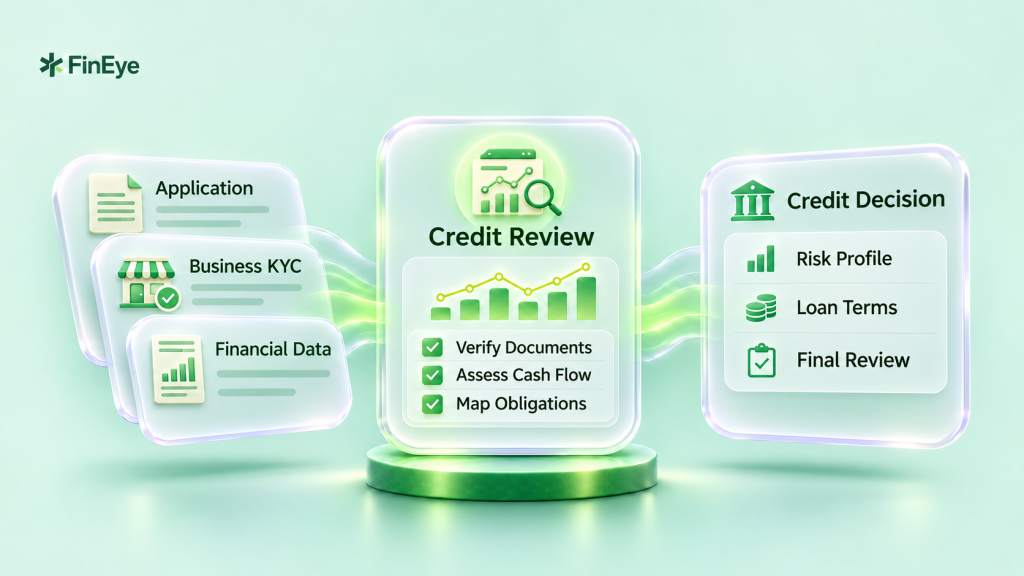
Most MSME underwriting runs in five stages.
Pre-screen. Apply policy filters before any detailed work: business vintage, turnover band, excluded industries, location, and a minimum bureau standard.
Collect and verify data. Gather KYC and KYB, bureau reports for the entity and promoters, bank statements, GST returns, ITRs and financial statements, and check that each is genuine.
Analyse and score. Work out repayment capacity from cash flows, leverage from the balance sheet, and conduct from banking and bureau history, then apply a scorecard or rule set.
Decide. Approve, decline, or refer; set the limit and pricing; and record any deviation from policy with the authority that approved it.
Monitor and learn. Track the account after disbursement, watch for early warning signals, and feed defaults and near-misses back into the rules.
The last stage is the one most often skipped. Underwriting that never learns from its own portfolio repeats the same mistakes at larger volumes.
Four Credit Underwriting Models Lenders Use
Model
How it decides
Best suited to
Main weakness
Judgemental
An analyst reviews the file against policy and writes a memo
Larger tickets and complex structures
Slow and inconsistent across analysts
Scorecard
A statistical score from bureau and application data, with cut-offs by band
High-volume, small-ticket loans
Weak on thin-file MSMEs, and needs past performance data to build
Rule-based automated
Policy rules coded into a decision engine, with straight-through approval within limits
Standardised products and digital journeys
Rules go stale, and edge cases still need referral
Cash-flow underwriting
Repayment capacity read from bank and GST transaction data rather than collateral or bureau history
New-to-credit and collateral-free MSMEs
Only as good as the completeness and integrity of the data
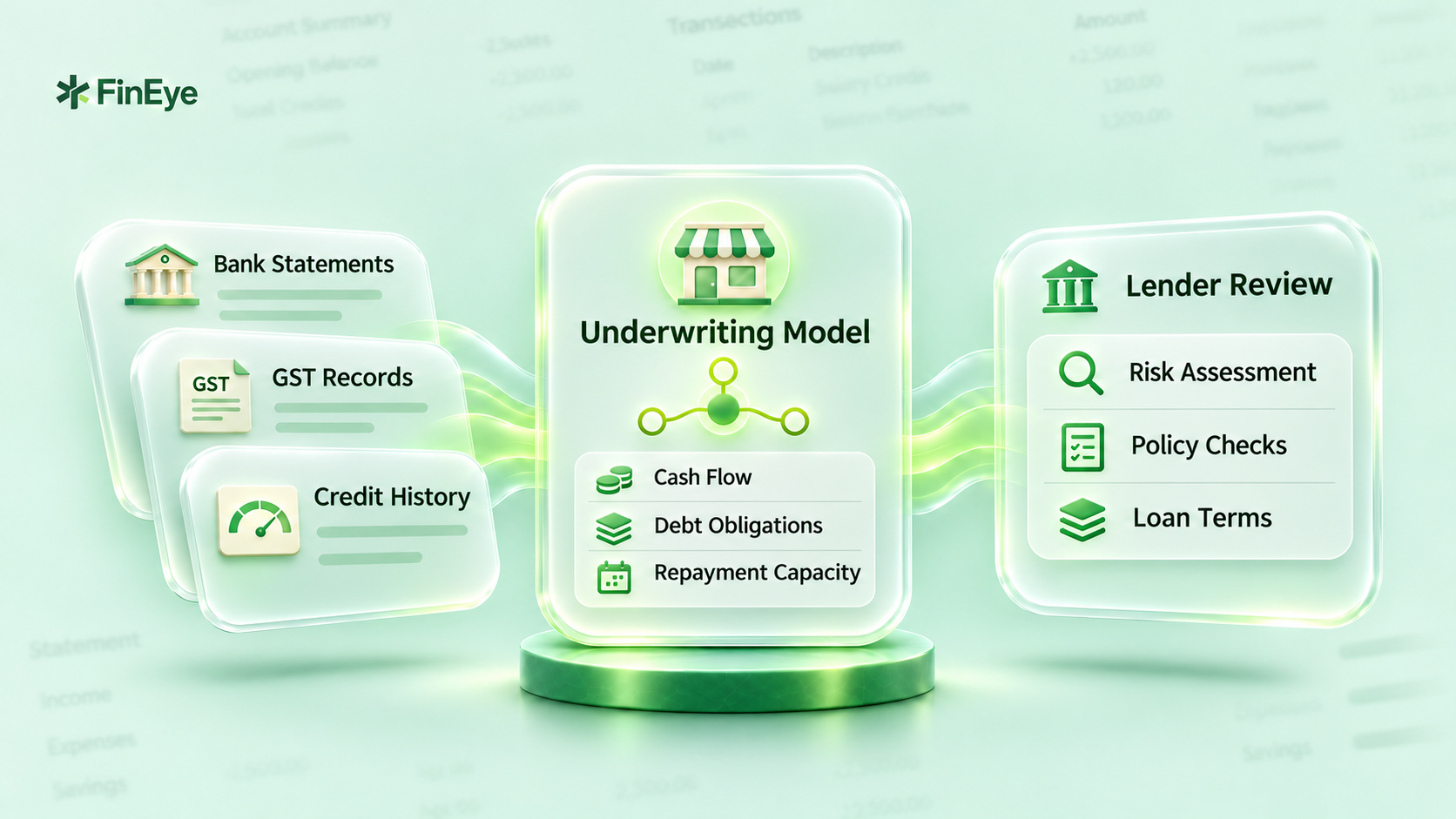
Few lenders use one model alone. A common design runs automated rules for screening and small loans, applies cash-flow analysis to every MSME file, and sends larger or flagged cases to an analyst.
Cash-flow underwriting matters most for India’s smaller businesses. Many have short or no commercial bureau histories and limited audited financials, but many file GST returns and run their business through a current account. Their transactions say more about repayment capacity than their balance sheets do.
The Data Behind an MSME Underwriting Decision
Data source
What it shows
Common pitfall
Credit bureau reports
Repayment history and current exposure of the entity and promoters, reported fortnightly since 1 January 2025
Thin or missing files, and informal borrowing never appears
Bank statements
Cash flow, existing obligations and payment conduct
Partial accounts and edited PDFs
GST returns
Declared turnover, filing regularity and the spread of customers and suppliers
Non-GST income is missing, and filing gaps distort trends
ITR and financial statements
Profitability, net worth and leverage
Annual, lagged and self-reported
Udyam, MCA and KYB records
Identity, vintage, MSME category and directors
Static, and rarely updated
The strongest decisions come from reconciling these sources, not from any one of them. Take an MSME with GST turnover of ₹4.6 crore, bank credits of ₹4.3 crore, and ITR turnover of ₹4.4 crore. The three agree within about 7%, so the underwriter can rely on turnover of roughly ₹4.4 crore. If the ITR showed ₹2 crore, the gap itself would be the finding.
For the bank statement side in detail, including which credits to strip out before any ratio, see our guide tobank statement analysis for lending.
Designing Underwriting Rules That Scale
Rules that work at 50 files a month often fail at 5,000. A few design choices keep them reliable:
Write every rule as a testable threshold with a stated reason, so it can be checked against outcomes later.
Keep knock-out rules few and firm, and treat everything else as a scoring factor.
Define referral triggers that send a file to an analyst instead of declining it outright.
Name the authority that can approve each deviation, in line with the lender’s delegation of powers.
Track each rule’s effect on approval rate, turnaround time,e and early delinquency, and retire rules that do not predict losses.
Test changes on a sample of files before rolling them out across the book.
An illustrative rule set for a small-ticket MSME working capital product (thresholds vary by lender):
Rule type
Example
Action when triggered
Knock-out
Business vintage under two years
Decline
Knock-out
Statement fails integrity checks and cannot be refetched through Account Aggregator
Decline or refer
Scoring factor
Gap between bank credits and GST turnover
Score falls as the gap widens
Referral trigger
More than two inward returns in six months
Analyst review
Limit rule
Working capital capped at 20% of assessed turnover for MSE limits up to ₹5 crore
Limit set at the lower of the rule and the request
For larger working capital limits, the MPBF method replaces the turnover rule in the last row.
Regulatory Guardrails for Credit Underwriting in India
RBI leaves underwriting design to lenders, but sets firm boundaries around it.
Board-approved credit policy. RBI’s Credit Risk Management Directions for commercial banks, issued on 28 November 2025, require board-approved credit risk policies and consistent assessment of creditworthiness and repayment capacity.
Digital lending. The RBI (Digital Lending) Directions, 2025, issued on 8 May 2025, require lenders to record the borrower’s economic profile, including age, occupation and income, before lending. They bar automatic increases in credit limits without an explicit request, and require a Key Fact Statement for every loan.
Responsibility for partners. Under the same directions, the lender remains fully responsible for the acts of its lending service providers, and a default loss guarantee does not replace credit appraisal.
MSME rules. Banks cannot take collateral on micro and small enterprise loans of up to ₹20 lakh sanctioned or renewed from 1 April 2026, and must decide on MSE loans of up to ₹25 lakh within 14 working days.
Models and AI. RBI’s FREE-AI committee report of 13 August 2025 sets out seven principles and 26 recommendations for responsible AI in finance, a sign that model-driven credit decisions will face closer governance.
FinEye provides the data layer for cash-flow underwriting. Its Bank Statement Analyserand GST Analyser turn statements and returns into categorised data and ratios, delivered in PDF and JSON for a decision engine or loan origination system. The Account Aggregator module brings statements in with the borrower’s consent.
Conclusion
Underwriting quality is decided less by the model a lender picks than by the data it trusts and the discipline it applies to its own rules. A simple rule set on verified data usually beats a sophisticated model on documents nobody checked.
For MSME lending, that points one way. Bank and GST transactions, fetched with consent and reconciled with bureau and tax data, give underwriters a view of repayment capacity that collateral never could. Lenders that build their rules around that evidence, and keep testing those rules against outcomes, can grow volumes without growing losses at the same pace.
Credit underwriting is the process a lender uses to assess a borrower’s risk and decide whether to lend, how much, at what price and on what conditions. It draws on bureau reports, bank statements, GST returns, financial statements, and the lender’s credit policy.
What are the steps in the credit underwriting process?
A typical process has five stages: pre-screening against policy, collecting and verifying data, analysis and scoring, the credit decision with limit and pricing, and post-disbursement monitoring that feeds back into the rules.
What is the difference between credit underwriting and credit appraisal?
In practice, they describe the same work. Banks in India usually say credit appraisal for the full assessment of a loan proposal, while NBFCs and fintech lenders more often say underwriting, especially for automated or digital decisions.
What is cash flow-based underwriting?
Cash-flow underwriting judges repayment capacity from the borrower’s actual inflows and outflows, mainly bank statements and GST data, rather than relying on collateral or a long bureau history. It suits new-to-credit and collateral-free MSME loans.
Can credit underwriting be fully automated?
Standardised small-ticket products can be approved straight through within coded rules. Larger or unusual files, and any file that triggers an integrity or mismatch flag, still need analyst review. Under RBI’s rules, the lender stays responsible for the decision either way.





 November 4, 2026
 9 min read