Bank Statement Analysis for Lending: Metrics, Methods, and Red Flags for Indian Lenders
shivam jadon
Featured
A bureau report shows how a borrower has repaid in the past. A bank statement shows how the borrower runs money today: where it comes from, where it goes, and how close the account gets to empty before each EMI date.
That is why bank statement analysis sits at the centre of most Indian loan files, from personal loans to MSME working capital. It is also where many files are weakest. Statements arrive as editable PDFs, cover one account out of several, and get reviewed by hand under a deadline.
This guide explains what lenders look for in a bank statement, the metrics that drive credit decisions, a six-step method, a worked MSME example, and the red flags worth stopping a file for.
Key Takeaways
Bank statement analysis estimates income, existing obligations, cash flow stability and payment conduct, and checks that the statement itself is genuine.
Gross credits overstate income. Own-account transfers, loan disbursements and reversals must come out before any ratio is calculated.
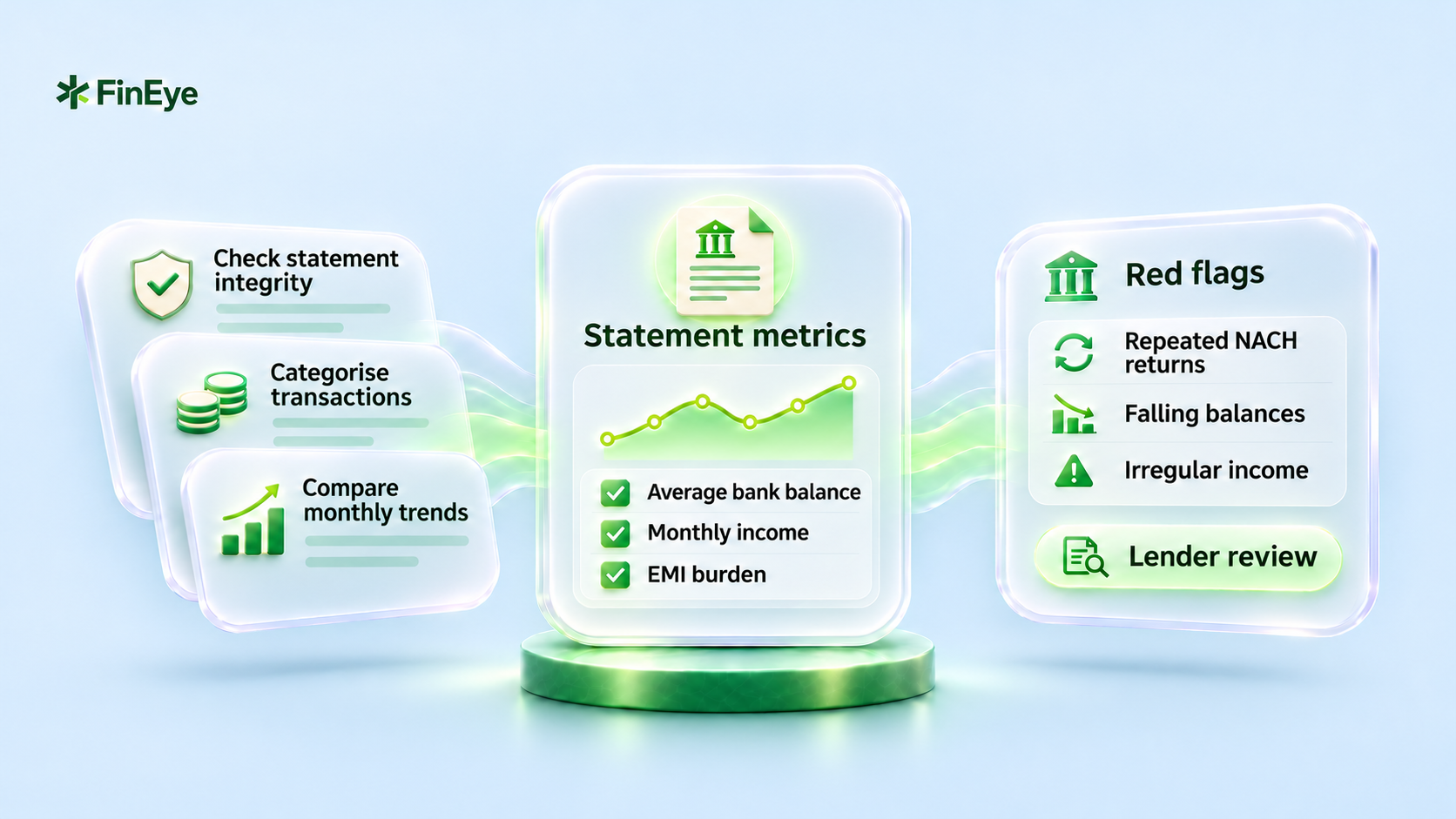
The metrics that matter most are business credits, average bank balance, EMIs and FOIR, bounces, cash deposit share and counterparty concentration.
Inward cheque or NACH returns, where the borrower’s own payment fails, are a stronger warning than outward returns.
Statements fetched with consent through the Account Aggregator framework remove most tampering risk, and reconciling bank data with GST and bureau data catches most of the rest.
What Bank Statement Analysis Means in Lending
Bank statement analysis is the review of a borrower’s transaction history to estimate income, existing obligations, cash flow stability, and payment conduct. It also tests whether the statement is genuine and complete.
Lenders usually ask for six months of statements from salaried applicants and six to 12 months from businesses, covering every operative account. The exact period is set by each lender’s credit policy.
The analysis answers four questions:
How much money comes in, and how regularly?
How much of it is already committed to EMIs, rent, and other fixed payments?
How much buffer does the account keep between inflows and outflows?
Can the statement be trusted, and does it agree with GST TR and bureau data?
The emphasis differs by borrower. For salaried applicants, the work centres on the salary credit, existing EMIs, and FOIR. For MSMEs, it centres on business credits, customer concentration, cash deposits, cheque returns and how hard the working capital limit is being used.
The Metrics Lenders Calculate From a Bank Statement
Metric
How it is calculated
What it tells the lender
Business credits
Total credits less own-account transfers, loan disbursements, refunds and reversals
Real sales or income flowing through the account
Average bank balance (ABB)
Daily closing balances averaged, or balances on fixed dates each month, as the credit policy defines
The buffer available to absorb an EMI
Fixed obligations
Recurring debits to lenders, NACH and ECS mandates, rent
Debt and commitments already carried
FOIR
Existing plus proposed EMIs ÷ net monthly income
Room for a new loan
Cheque and NACH returns
Inward and outward returns counted month by month
Payment discipline and customer quality
Cash deposit share
Cash credits ÷ business credits
Reliance on cash, and how much source checking is needed
Counterparty concentration
Share of credits from the top five payers
Dependence on a few customers
Limit utilisation
Average cash credit or overdraft balance ÷ sanctioned limit or drawing power
Working capital stress
The two kinds of return are often confused. An inward return is the borrower’s own cheque or EMI debit that fails for lack of funds. An outward return is a cheque the borrower deposited that bounced at the payer’s bank. Inward returns point to the borrower’s liquidity; outward returns point to the quality of its customers.
For how cash credit utilisation is tested against stock and receivables, see our guide to drawing power calculation.
How to Analyse a Bank Statement for a Loan: Six Steps
Get the right statements. Collect every operative account for the full period. Where possible, fetch them with the borrower’s consent through the Account Aggregator frameworkor net banking, rather than accepting uploaded PDFs.
Check integrity before analysis. Each opening balance should equal the previous closing balance, running balances should recompute, fonts and metadata should be consistent, and the account holder’s name and number should match KYC.
Categorise every transaction. Separate business or salary receipts from transfers between the borrower’s own accounts, loan disbursements, refunds, cash, EMIs, tax payments and utilities.
Calculate the metrics. Work out monthly business credits, ABB, EMIs, FOIR, returns, cash share, and concentration, month by month rather than as single totals.
Reconcile with other evidence. Compare business credits with GST invoice values, salary credits with salary slips, and EMIs found in the statement with the bureau report.
Read the pattern and record it. Note trends, seasonality and one-off items, and write the conclusions and open questions into the credit appraisal memo.
A Worked Example: Six Months of an MSME Current Account
The figures below are illustrative. A wholesale trader applies for a working capital limit and shares six months of its only current account.
Month (₹ lakh)
Gross credits
Less: own transfers and loan credits
Business credits
Cash deposits
Inward returns
April
48
6
42
5
0
May
51
4
47
6
0
June
39
3
36
4
1
July
44
5
39
7
0
August
62
18
44
6
0
September
46
4
42
5
1
Total
290
40
250
33
2
What the analyst concludes:
Gross credits overstate business inflows by 16%. August alone carried ₹18 lakh of a loan disbursement and transfers from the promoter’s savings account.
Business credits average ₹41.7 lakh a month, or about ₹5 crore a year.
Cash deposits are 13% of business credits, plausible for a trader with walk-in buyers. Any single large deposit still needs a source.
GSTR-1 invoice value for the same months, including tax, is ₹262 lakh. Business credits are 95% of invoiced sales, consistent with some sales still outstanding.
NACH debits show EMIs of ₹1.1 lakh a month to two lenders, and the bureau report shows the same two loans.
The two inward returns, in June and September, cleared within three days. They are worth a question, not a decline.
The file is consistent across bank, GST, and bureau data. The open question is liquidity: month-end balances stay low relative to inflows, which supports the working capital need but also limits the size of any new EMI.
Red Flags in Bank Statement Analysis
Red flag
What it can mean
Next check
Round-figure credits from a few parties that leave within days
Circular transactions that inflate turnover
Trace counterparties and match them with GST data
Large credits just before the statement ends or around balance dates
Window-dressing of balances
Use daily ABB and ask for the source
Salary credited by IMPS or UPI from an individual, or on shifting dates
Salary that is not from an employer
Verify the employer and payroll records
Regular debits to individuals or unregistered lenders
Borrowing that the bureau does not show
Ask the borrower; adjust FOIR
Repeated inward cheque or NACH returns
Liquidity stress or weak payment discipline
Count returns and how fast they are cured
Opening balance that does not match the previous closing balance
An edited statement
Run tamper checks; fetch the statement through AA
Cash deposits out of line with the business type
Unreported income or third-party funds
Ask for source documents
Frequent transfers to accounts not shared with the lender
An undisclosed account
Ask for statements of all accounts
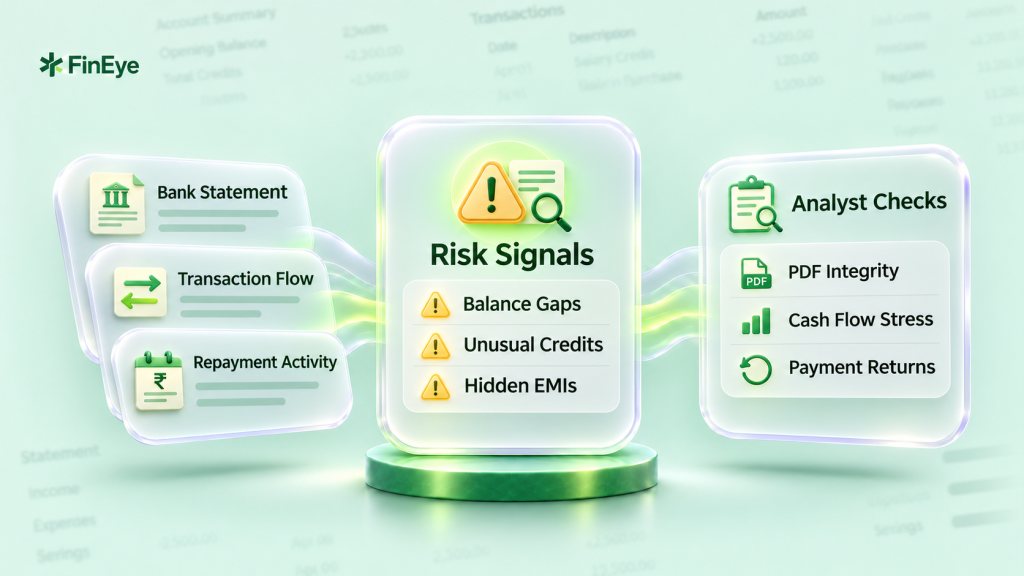
No single flag decides a file. Two or more together, especially an integrity flag with a turnover flag, usually justify a referral to a senior analyst.
Manual vs Automated Bank Statement Analysis
Aspect
Manual review
Automated analysis
Speed
Slow for multi-account and 12-month files
Minutes per file
Coverage
Analysts sample months and large transactions
Every transaction is categorised
Consistency
Varies by analyst and workload
Same rules on every file
Tamper detection
Visual checks
Metadata, font and balance arithmetic checks
Judgement
Strong on context
Needs an analyst to review the flags it raises
The workable model combines both. Software does the parsing, categorisation, ratios and integrity checks; the analyst reviews exceptions and writes the conclusion.
FinEye’s Bank Statement Analyser parses statements across bank formats, categorises transactions, detects EMIs and FOIR, calculates adjusted and forecasted ABB, flags tampering, and returns the report in PDF and JSON. ItsPre-Analysis and Data Parsing module checks statement quality and integrity before analysis begins, and the Account Aggregatormodule fetches statements with the borrower’s consent.
Conclusion
A bank statement is the closest a lender gets to watching a borrower’s business run. Read well, it shows real income, real obligations, and how much room the borrower has before the next payment fails.
The skill lies less in reading transactions than in cleaning and reconciling them: removing own-account and loan credits, matching inflows with GST, and testing the document before trusting it. As consent-based data through Account Aggregator becomes routine, the work shifts from checking whether a statement is real to deciding what it says about credit risk.
Bank statement analysis is the review of a borrower’s bank transactions to estimate income, existing obligations, cash flow stability and payment behaviour. Lenders also use it to check that the statement is genuine and consistent with GST, ITR, and bureau data.
How many months of bank statements do lenders check?
Most lenders ask for six months from salaried applicants and six to 12 months from businesses, for every operative account. The exact period depends on the product and the lender’s credit policy.
What do lenders look for in a bank statement for a loan?
They look at regular income or business credits, existing EMIs, average balances, cheque and NACH returns, cash deposits, large or unusual transactions, and transfers to accounts the borrower has not disclosed.
What is the difference between inward and outward cheque returns?
An inward return is a cheque or debit issued by the account holder that fails, usually for insufficient funds. An outward return is a cheque the account holder deposited that bounced at the payer’s bank. For a lender, inward returns are the stronger warning sign.
How do lenders detect a fake bank statement?
They check that balances recompute and carry forward correctly, look for font and metadata changes from PDF editors, match account details with KYC, and compare credits with GST and salary records. Fetching statements through the Account Aggregator framework avoids the edited-PDF problem altogether.





 November 4, 2026
 9 min read