What Is Account Aggregator Interoperability? RBI’s December 2026 Deadline Explained
shivam jadon
Featured
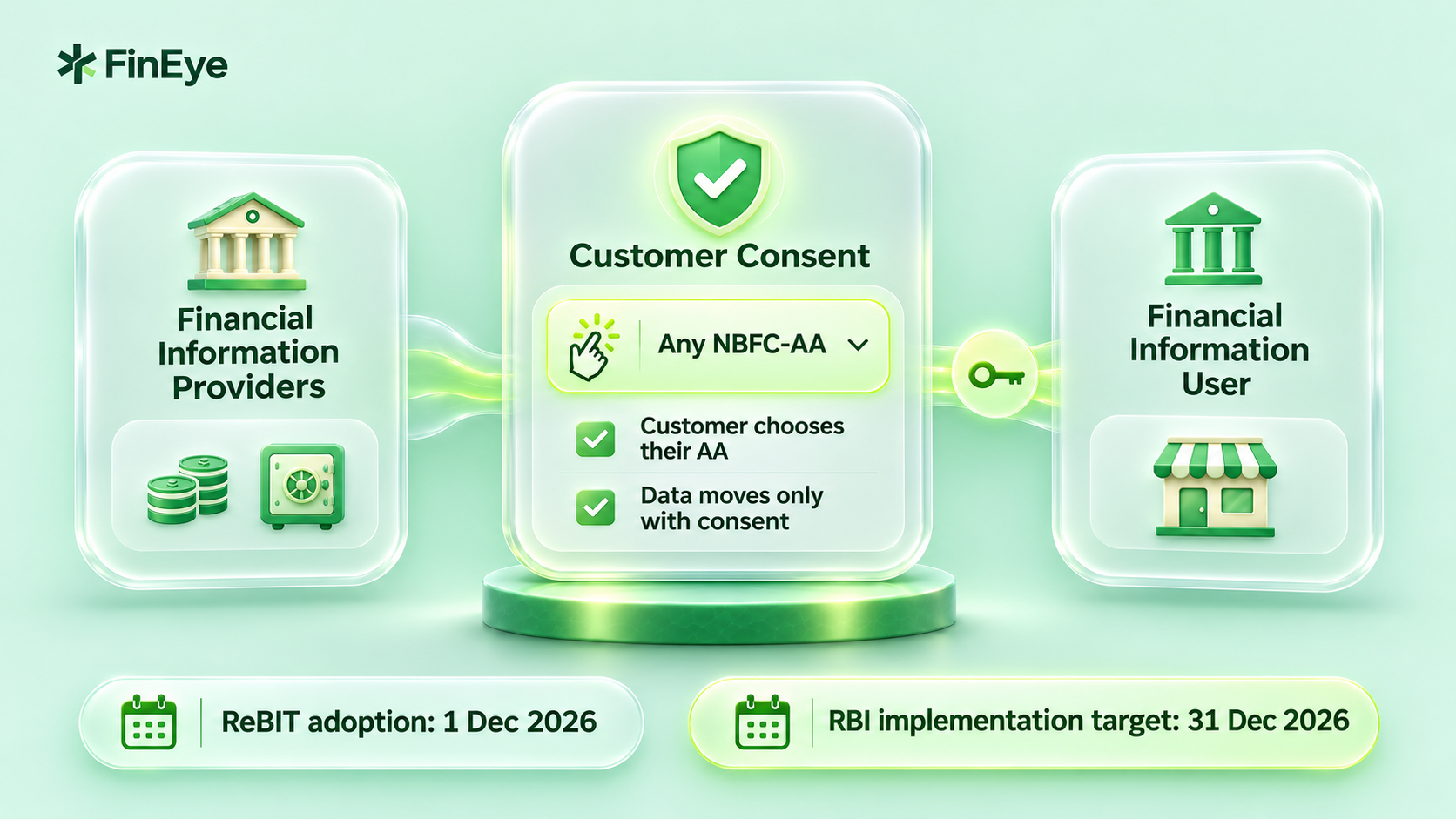
Account Aggregator interoperability means a customer can share financial data from any bank through any Account Aggregator (AA) they choose. The Reserve Bank of India (RBI) announced this on 7 October 2026, and expects it to be in place by 31 December 2026.
In simple terms, you will only need to sign up with one AA. That one AA will be able to fetch your data from every bank and financial institution on the network.
This sounds like a small technical change. For lenders, it is a big one. Today, many loan applications drop off at the AA step because the customer’s bank is not connected to the lender’s AA. After December, that problem should largely go away.
In this blog, we explain what RBI announced, how interoperability works, and what it changes for borrowers and lenders.
Key Takeaways
RBI announced two Account Aggregator measures on 7 October 2026. Both are expected to be implemented by 31 December 2026.
With interoperability, a customer can share data from any bank through any AA, after signing up with just one.
SEBI-regulated depositories will also be able to show bank deposit details in the Consolidated Account Statement (CAS), next to demat holdings.
For lenders, fewer AA journeys should fail because of missing bank coverage, and connecting to several AAs only for coverage becomes unnecessary.
Consent rules stay the same. The customer still decides what data is shared, with whom and for how long.
What Did RBI Announce on 7 October 2026?
RBI announced two customer-focused measures under the Account Aggregator framework. They were part of its Statement on Developmental and Regulatory Policies, released alongside the October 2026 monetary policy.
Interoperability Among NBFC-Account Aggregators: Customers will be able to access and share their financial information through any AA of their choice. RBI Governor Sanjay Malhotra explained that users will be able to pull data through all AAs by onboarding with just one.
Bank Deposits in the Consolidated Account Statement (CAS): SEBI-regulated depositories will be able to include bank deposit details in the CAS through Account Aggregators. Demat account holders will then see their deposits and their investments in one statement.
These RBI Account Aggregator new rules are expected to be implemented by 31 December 2026. Keep in mind that this is a rollout target. Banks, AAs and depositories still need to make the changes on their side, so the experience may improve gradually rather than overnight.
First, What Is an Account Aggregator?
An Account Aggregator is an RBI-regulated NBFC that moves your financial data from one institution to another, only with your consent. It does not read or store your data. It simply acts as a secure pipe.
Three parties are involved in every AA data request:
Financial Information Provider (FIP): It is the institution that holds your data, such as your bank
Financial Information User (FIU): It is the institution that wants your data, such as a lender.
Account Aggregator (AA): It is the consent manager that carries the data from the FIP to the FIU.
For example, when you apply for a personal loan, the lender (FIU) asks for your bank statement. You approve the request on the AA app, and the AA fetches the statement from your bank (FIP) and sends it to the lender. You don’t need to upload any PDFs or log in to net-banking portals.
What Does Account Aggregator Interoperability Mean?
Interoperability means different AAs can work with each other, so your choice of AA no longer limits which banks you can share data from.
The easiest way to understand the AA interoperability meaning is to think of UPI. You can use any UPI app to pay from any bank account. It doesn’t matter which app you use or where your account is.
Account Aggregators for lenders today work more like old phone networks that could only connect calls within the same network. There are 17 operating AAs, but each one has its own set of bank integrations. If your bank isn’t connected to the AA your lender uses, the data simply can’t flow. After interoperability, AAs will work much more like UPI. One AA, any bank.
A Simple Example
Riya applies for a ₹3 lakh personal loan on a lender’s app. Her salary account is with Bank X. The lender uses AA-1, but AA-1 has not integrated with Bank X.
Today: The journey stops. Riya is asked to register with a different AA. Most people don’t, so she either uploads a PDF statement or drops off.
After 31 December 2026: Riya gives consent once on AA-1. The request reaches Bank X through the interoperable network, and her statement reaches the lender in minutes.
What Changes After 31 December 2026?
Here is a quick before-and-after view of the Account Aggregator system.
Area
Before Interoperability
After Interoperability
Bank Coverage
Limited to the banks your AA has integrated with
Any bank on the network, through any AA
Customer Onboarding
May need to register with more than one AA
One AA is enough
Lender Setup
Many lenders connect to 2–3 AAs to cover more banks
One AA can cover all banks
Failed Journeys
Common when the bank isn’t supported
Expected to drop sharply
Choosing an AA
Based largely on bank coverage
Based on success rate, speed and experience
Consent Rules
Customer controls what, with whom and for how long
No change
What Does Adding Bank Deposits to CAS Mean?
A Consolidated Account Statement (CAS) is a single statement that shows your shares, bonds and mutual funds across demat accounts. Depositories like NSDL and CDSL send it to investors every month.
Until now, the CAS has left out bank deposits. So an investor could see their stocks and mutual funds in one place, but their savings account and fixed deposits sat in separate bank statements.
With RBI’s new measure, depositories will be able to pull bank deposit details through Account Aggregators and show them in the CAS.
Let us understand this with the help of an example. Amit holds shares and mutual funds through his demat account, a savings account with one bank and an FD with another. Today, he checks three different places to know his total savings. Once the change is live, his CAS can show all of it in a single statement.
A few points to keep in mind:
This only adds deposit information to the CAS. Your money stays in your bank.
It works through the AA framework, so your consent is still needed.
People without a demat account can continue to view and share their financial information through AAs as they do today.
What Interoperability Means for Borrowers
For borrowers, this is simply good news:
Fewer Dead Ends: Your loan application won’t stop just because your bank isn’t connected to the lender’s AA.
Less Paperwork: Fewer requests to download and upload PDF statements.
One App to Manage Consents: You can stick with the AA you already trust and use it with any lender.
Same Control: You still approve every request and can revoke consent at any time.
What Interoperability Means for Lenders
Lenders stand to gain the most from this change, because the AA step is where many digital loan journeys break today:
Higher Completion Rates: When a customer’s bank isn’t supported, the application usually falls back to a PDF upload or ends there. Interoperability removes one of the biggest reasons for these drop-offs.
Simpler Integrations: Many lenders today connect to two or three AAs and route each customer to whichever one supports their bank. That means extra integrations, contracts and monitoring. After December, connecting to several AAs only for coverage becomes unnecessary. Lenders may still use more than one AA for reliability, since success rates can differ.
Wider Access to Bank Data: With AA data reaching more borrowers, lenders can rely more on verified, bank-sourced transaction data for underwriting. This matters a lot for thin-file borrowers and MSMEs, where bank statements often tell you more than the credit score does.
PDFs Won’t Disappear: Some customers will still share PDF statements, and some data will still come from outside the AA network. Lenders need to handle both formats well.
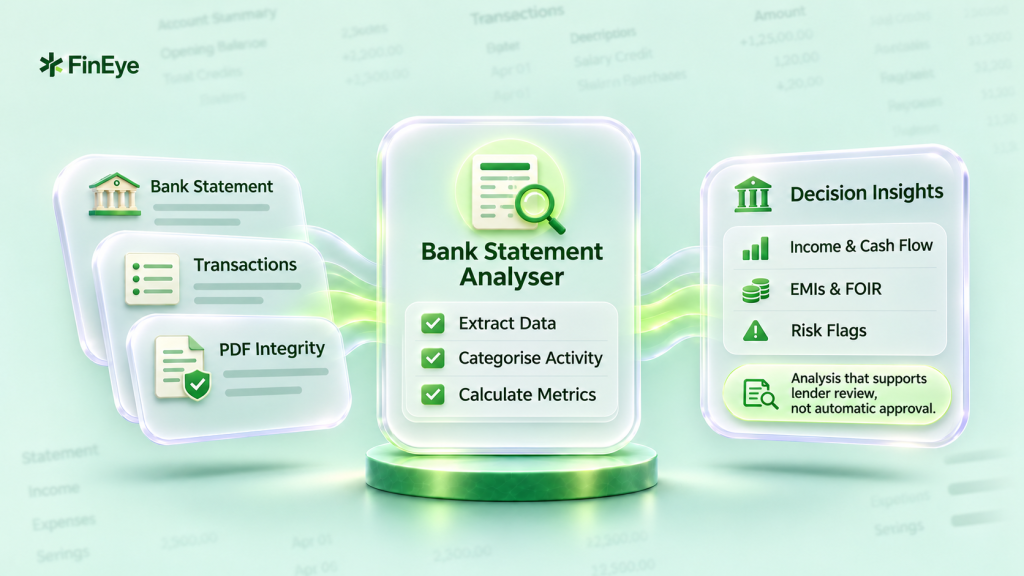
This is where a tool like FinEye’s Bank Statement Analyser helps. It works with both Account Aggregator data and PDF bank statements, so lenders can assess every applicant the same way, whichever route the data takes.
What Interoperability Means for Account Aggregators
Until now, bank coverage was one of the main ways AAs competed with each other. Interoperability takes that away.
From 2027, AAs are likely to compete on:
Success Rate: How often a data request actually goes through.
Speed and Reliability: How quickly and consistently data reaches the lender.
Customer Experience: How simple the consent screen is.
Value-added Services: Analytics, dashboards and tools built on top of the core service.
Other AA Changes Lenders Should Know About
Interoperability is not the only change in the Account Aggregator ecosystem this year. Here are other changes lenders should be aware of:
Sahamati became the self-regulatory organisation (SRO). RBI recognised Sahamati as the SRO for the AA ecosystem on 5 June 2026. Supporting interoperability is now part of its role.
A common fee model went live on 1 November 2026. Lenders (FIUs) now pay a standard fee for every successful data fetch, shared between the bank, the AA and Sahamati. The fee depends on how much history is requested, and customers can’t be charged for sharing data through an AA.
What Is Still Unclear?
Some operational details are still being worked out. The biggest open question is settlement. When a consent goes through one AA, and the data comes back through another, it isn’t yet clear how fees will be split between them. Sahamati is still finalising this, so lenders should watch for updates before December.
Key Dates at a Glance
Date
What Happens
5 June 2026
RBI recognises Sahamati as the SRO for the AA ecosystem
7 October 2026
RBI announces AA interoperability and bank deposits in CAS
1 November 2026
Common AA fee model goes live
31 December 2026
Target date for AA interoperability and bank deposits in CAS
Conclusion
RBI’s move to make Account Aggregators interoperable fixes one of the biggest gaps in India’s open banking system. Once it is live, a customer will need just one AA to share data from any bank, and lenders won’t lose applicants simply because a bank isn’t connected.
For lenders, the next step is to get ready. Review how many AAs you connect to and why, plan for higher AA volumes, and make sure your underwriting can read both AA data and PDF statements consistently. FinEye’s Bank Statement Analyser is built for exactly that, helping lenders turn bank data into faster, more confident credit decisions.
Frequently Asked Questions
What is Account Aggregator interoperability?
It means customers can access and share financial data from any bank or financial institution through any Account Aggregator of their choice. They only need to sign up with one AA.
When will Account Aggregator interoperability start?
RBI expects it to be implemented by 31 December 2026. Since banks and AAs need to update their systems, the full benefit may show up gradually.
Do I need to change my Account Aggregator app?
No. You can keep using the AA you already have. After interoperability, it should be able to reach any bank on the network.
Will my consent rules change?
No. You still decide what data is shared, with whom, for what purpose and for how long. You can revoke consent at any time.
What is a Consolidated Account Statement (CAS)?
A CAS is a single statement from depositories like NSDL and CDSL that shows your shares, bonds and mutual funds in one place. RBI’s new measure will allow bank deposit details to be added to it through Account Aggregators.
Will my bank deposits move to my demat account?
No. Only deposit information will appear in the CAS. Your money stays in your bank account.
How does AA interoperability help lenders?
It reduces failed loan journeys caused by missing bank coverage, removes the need to connect to several AAs just for coverage, and gives lenders access to verified bank data for more applicants.
Do customers have to pay to share data through an AA?
No. Under the AA fee model that went live on 1 November 2026, the lender pays for each successful data fetch. Customers can’t be charged for sharing data through an AA.





 November 10, 2026
 11 min read