How a Leading Bank Uncovered Risks in a ₹2 Crore Working Capital Loan
shivam jadon
Featured
The Client:
A leading Indian bank serving MSME and commercial borrowers wanted to strengthen how it screened working capital applications and monitored active cash credit facilities. Its credit teams had access to banking records and relevant borrower information, but they needed a practical way to connect these records when something did not add up.
The bank tested the approach through a cosmetics manufacturer seeking a ₹2 crore working capital facility. The borrower had regular GST filings and consistent account activity. The application initially appeared suitable for detailed assessment.
The Challenge: Detecting Risk Before and After Disbursal
The bank needed answers to two questions. Before sanction, did the applicant’s reported activity match the business relationships and operating records behind it? After disbursal, were funds moving toward legitimate business needs and did the inventory reported for renewal stand up to a financial reconciliation?
The issue was not missing documents. It was finding specific exceptions early enough for the credit team to investigate them, without holding up genuine transactions or treating every related-party payment as suspicious.
How FinCheck Was Used
Stage 1 – Early Warning Signals Before Sanction
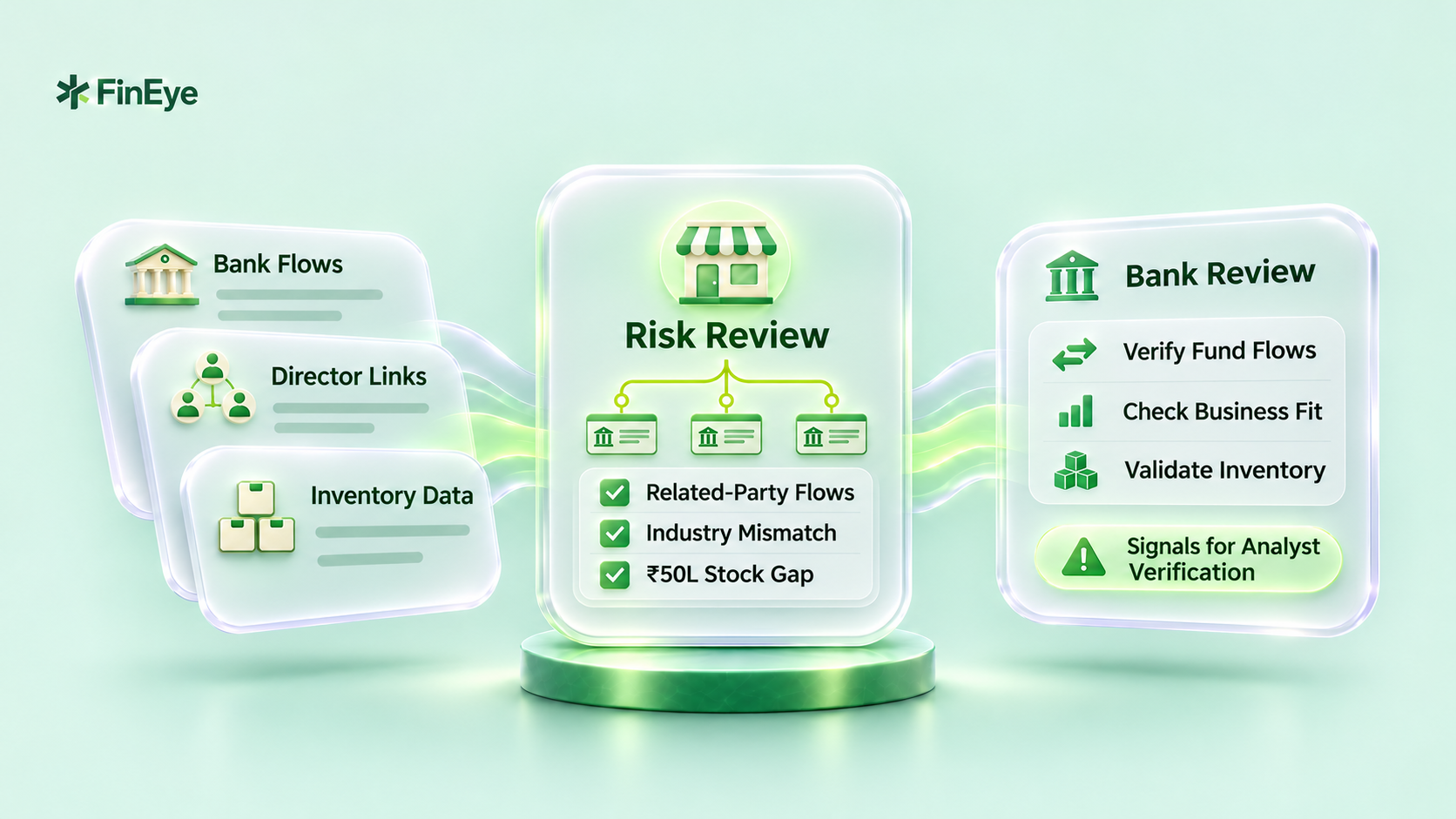
The bank used the borrower’s available banking records, GST information and EPFO data obtained through authorized APIs to assess the application before detailed underwriting. FinCheck connected the borrower to director-associated businesses and identified the sources of incoming funds.
Two findings required follow-up. A sizable share of credits came from a packaging company linked to one of the borrower’s directors. Separately, the manufacturer declared roughly 80 workers, while available EPFO records showed only six active PF contributors.
The credit team examined the packaging company’s business relationship with the manufacturer and requested documents supporting the transactions. It also asked the borrower to explain the workforce difference. The borrower stated that third-party staffing accounted for much of the workforce and the bank seeks records to verify that explanation.
These were review points, not automatic grounds for rejection. Once the exceptions had been documented and considered alongside the bank’s standard checks, the case could move through underwriting. In this scenario, the bank sanctioned the ₹2 crore facility and carried the related-party connection forward as an item for monitoring.
Stage 2 – Post-Disbursal Monitoring and Renewal Review
2.1 Related-Party Transfer: A Legitimate Payment or Fund Diversion?
A large transfer to the group-owned packaging company appeared in the borrower’s account. Because that relationship had already been identified before sanction, the monitoring team could examine the payment in context rather than flagging it solely because the recipient was related.
The team compared the payment with available GST counterparty information, product classifications and purchase documentation. The transfer had a credible link to packaging purchases for the manufacturer. It was documented as a related-party operating transaction, subject to the bank’s normal verification.
2.2 Counterparty Mismatch: Unrelated Business Transactions
A later GST review surfaced material transactions with a counterparty primarily associated with steel trading. For the cosmetics business, the commercial purpose was not immediately clear. The bank requested invoices and supporting records rather than assuming that a difference in HSN categories meant the sale was false.
The counterparty remained an open review item until the bank could establish what was supplied or sold and why the transaction belonged in the borrower’s operating activity.
Stock Verification: A ₹50 Lakh Gap in Declared Inventory
Ahead of renewal, the borrower submitted a stock statement showing ₹1 crore of inventory. The monitoring team compared that figure with an estimate built from historical purchases, sales and opening stock. Under the assumed selling-price-to-cost multiplier of 1.30, the calculation was:
Inventory Reconciliation
Amount
Opening inventory
₹30 lakh
Purchases
₹2.40 crore
Reported sales
₹2.86 crore
Estimated cost of goods sold
₹2.20 crore
Estimated closing inventory
₹50 lakh
Declared inventory
₹1 crore
Difference for reconciliation
₹50 lakh
The ₹50 lakh difference was passed to the credit team for reconciliation with stock registers, valuation methods, work-in-progress and physical verification. It was not treated as a confirmed stock shortfall. The estimate provided a reason to investigate before using the declaration in a renewal decision.
The bank therefore entered the renewal review with two defined questions: the commercial basis of the steel-trading transactions and the explanation for the inventory variance. Both were tied to specific records and could be followed up through its established credit process.
The Results
In this reconstructed case, FinCheck changed the way the bank organized and acted on its credit review. The value lay in surfacing specific issues at the right stage, not in producing a generic risk score.
Bank’s Problem
Difference in the Review Process
Related-party credits were hard to interpret
The bank identified the connected packaging business before sanction and sought transaction evidence.
Workforce information did not align
The EPFO discrepancy became a targeted document request rather than an automatic rejection.
Post-disbursal transfers lacked context
The bank assessed a large group-company payment against its commercial purpose and prior relationship.
Unusual trading activity could be overlooked
The steel-trading counterparty was singled out for invoice and business-purpose checks.
Stock declarations needed stronger support
The ₹50 lakh estimated variance became a specific reconciliation item before renewal.
Across the two stages, the bank was able to move from separate document checks to a single borrower story – what the business reported, who it transacted with, where the funds moved and what the inventory records supported. The resulting exceptions were available for verification, monitoring and renewal decisions.
No NPA reduction, fraud-prevention rate or turnaround-time improvement is asserted here; those outcomes would require verified implementation data.
Frequently Asked Questions
What does this ₹2 crore working capital loan case study cover?
It describes how a bank reviewed a cosmetics manufacturer’s application and monitored the facility using banking, GST and EPFO information.
How did FinCheck help identify risks before loan sanction?
FinCheck connected the borrower with a director-associated packaging company and surfaced a difference between the declared workforce and available EPFO records. These became follow-up questions for the bank.
What risks did the bank review after disbursal?
The bank examined a transfer to the related packaging company, transactions with a steel-trading counterparty and a ₹50 lakh difference between estimated and declared inventory.
Did the bank reject the ₹2 crore working capital loan?
No. In this reconstructed case, the bank sanctioned the facility after review and carried the related-party connection forward for monitoring. The identified exceptions were review points, not automatic grounds for rejection.
Was the ₹50 lakh inventory difference treated as a confirmed shortfall?
No. It was passed to the credit team for reconciliation with stock registers, valuation methods, work-in-progress and physical verification. The case study does not claim a confirmed shortfall or a specific improvement in lending outcomes.





 November 16, 2026
 6 min read