Turn a Week of Client Data Entry
into an Afternoon
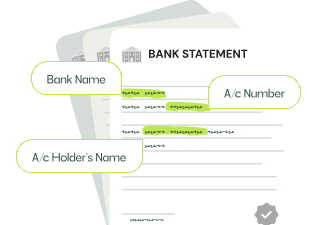
FinEye gives CA firms and accounting practices the data work behind filings, audits, CMA files and loan submissions. We read your clients’ bank statements and GST returns, categorise every transaction, reconcile declared turnover against what actually reached the account, and hand it back in Excel the same day.












Who We Work With


Chartered Accountancy Firms
Statutory and tax work across a mixed client book.


Tax Practitioners
Return preparation and assessment support where the bank account is the evidence.

.svg)
Audit Firms
Substantive testing that needs every transaction, not a sample.

.svg)
Outsourced Accounting Providers
Bookkeeping and compliance run at volume for other firms’ clients.

What Practice Work Actually Involves

The data arrives in whatever shape the client has it.
Scans, phone photographs, password-protected PDFs, three months missing from the middle of the year. The job starts with making the file readable.

.svg)
Deadlines cluster.
Filing and audit seasons put the same work on every client file in the same fortnight, and headcount is the only lever most firms have.

.svg)
Every bank formats its statements differently.
A template built for one bank breaks on the next, and across a client base no template survives.
.svg)
The preparation is not the billable part.
A junior spends a day keying a year of transactions so a senior can spend an hour forming a view. The client pays for the hour.
What FinEye Analyses
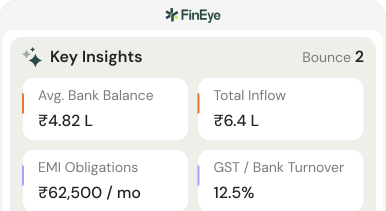
Every transaction extracted and categorised, with average balances, total inflows and outflows, EMI obligations and bounce history calculated for you.
Declared turnover reconciled against GST filings and the credits that actually landed in the account, with filing gaps and buyer or supplier concentration shown.
Every file screened for missing pages, period gaps and signs of alteration before work begins, which matters when your name goes on the output.

Output arrives as an Excel file in the same column structure every time, whichever bank the statement came from.
What Sets Fineye Apart

We Analyse, We do not just convert
A converter gives you the same transactions in a spreadsheet and leaves the reading to you. FinEye categorises every transaction, separates recurring obligations from one-off movement, and shows where money moved between a client’s related accounts. You start from a view of the account, not a retyped statement.

Priced for a Practice, not an Enterprise
FinEye costs less per statement than the established players, which is what makes it sensible to run on every client file rather than only the complicated ones
Questions
Accounting Teams Ask
Yes. Upload a statement in PDF, including a scanned one, and FinEye returns the transactions as a structured Excel file with date, description, amount and balance in separate columns. The transactions come back categorised, which a plain converter does not do.
 Can FinEye convert a bank statement PDF to Excel?

A free converter reproduces the table. FinEye reads it: transactions are categorised, recurring obligations identified, average balances and inflows calculated, and movement between a client’s related accounts flagged. You get a view of the account rather than a retyped statement.
How is this different from a free PDF-to-Excel converter?Yes. The figures a bank asks for — average balances, turnover, existing obligations and bounce history — come back calculated, so a CMA file or loan submission starts from finished numbers rather than a year of raw entries.
Can we use the output for CMA data and loan applications?Yes, including scans and photographs.
Does it handle scanned statements?Statements can be submitted in bulk, which is what most firms need during filing and audit season rather than one file at a time.
Is client data safe?Priced per statement, below the established players in this market.
How much does it cost?Further Reading for
CAs and Accountants
November 4, 2026 · 9 min read
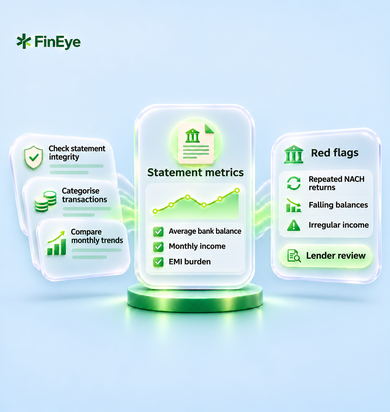
Bank Statement Analysis for Lending: Metrics, Methods, and Red Flags for Indian Lenders

Shivam Jadon
Digital Marketing Associate
November 4, 2026 · 9 min read
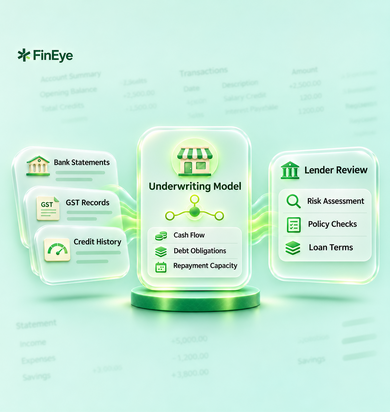
Credit Underwriting for MSME Loans: Process, Models, and the Data Behind Each Decision
Shivam Jadon
Digital Marketing Associate
November 3, 2026 · 12 min read
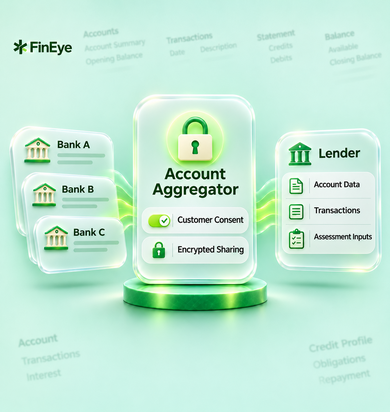
What is an Account Aggregator for Lenders? Understanding Meaning, Features & Benefits
Shivam Jadon
Digital Marketing Associate
 MSME Lending Intelligence Platform
- +91 96670 90342
- info@fineye.co
- Noida, Uttar Pradesh, 201301
Resources
Blogs
▶