Credit Underwriting Process in India: Step-by-Step for NBFCs
shivam jadon
Featured
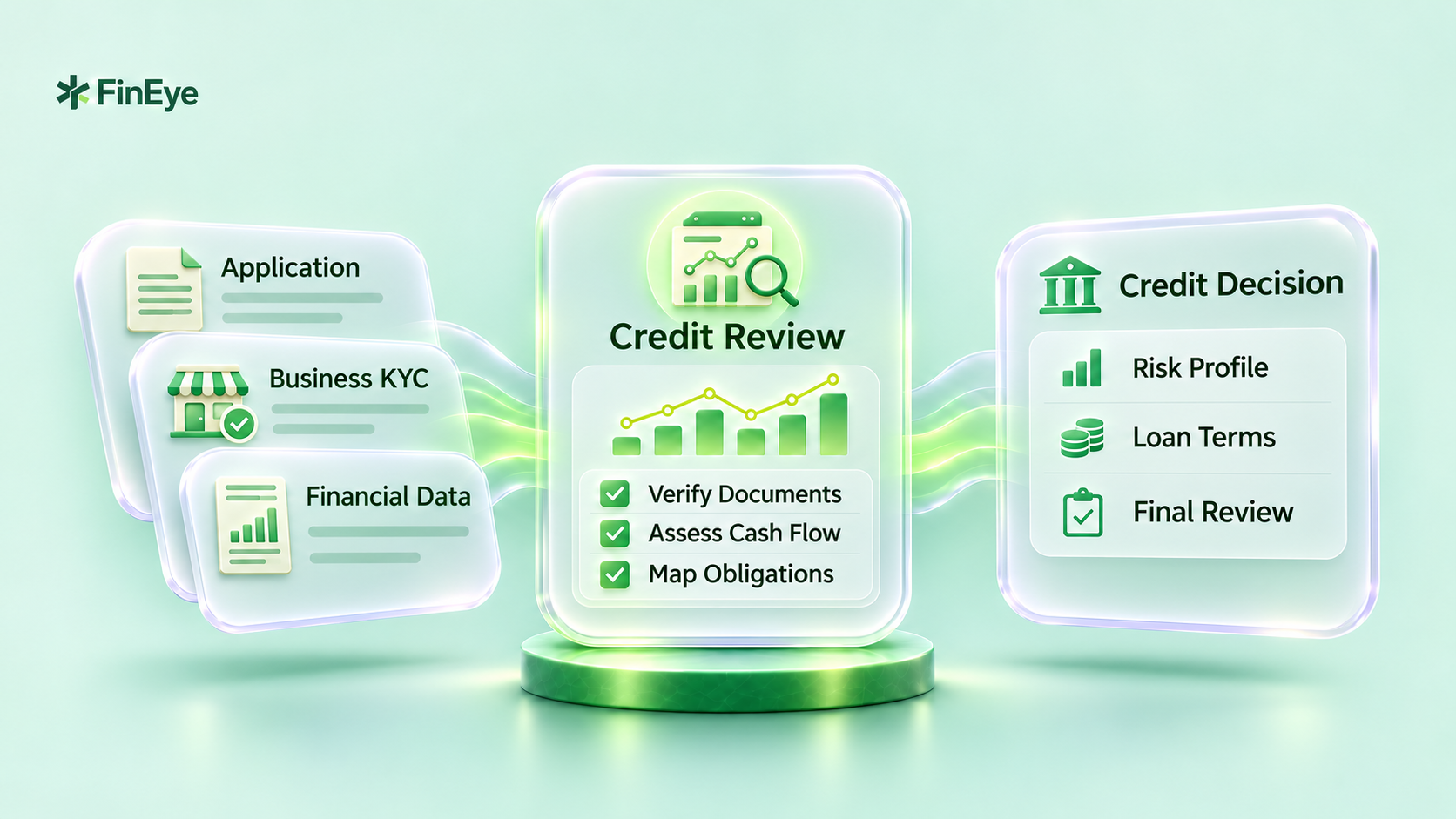
Credit underwriting is how an NBFC decides whether to give a loan, how much to give, and at what interest rate. In India, it usually follows these steps: loan application, KYC, credit bureau check, income analysis, repayment capacity check, verification, credit decision and disbursement.
Every loan an NBFC gives is a bet that the borrower will pay it back. Underwriting is how the NBFC makes that bet a safe one.
In this blog, we explain each step of the credit underwriting process in simple terms. We’ll follow one borrower from the day she applies to the day her loan is paid out, so you can see exactly how it works.
Key Takeaways
The credit underwriting process in India means checking a borrower before giving them a loan.
For NBFCs, it usually has 11 steps, from application to monitoring.
The key checks are the credit report, income, existing loans and ability to repay.
Digital lending follows the same steps, just faster and mostly automated.
RBI rules, like the Key Fact Statement and faster credit reporting, shape underwriting today.
What Is Credit Underwriting?
The credit underwriting process in India is how a lender checks whether a borrower can and will repay a loan. Think of a landlord checking a tenant’s job, past rent record and budget before handing over the keys. Underwriting works the same way. It answers three questions: Should we lend? How much? On what terms?
You’ll also hear about the credit appraisal process. It’s often used to mean the same thing, though strictly it’s the part where the borrower’s finances are assessed.
Why Underwriting Matters More for NBFCs
NBFCs often lend to self-employed people, small businesses and first-time borrowers, whom banks find harder to assess. For them, a credit score alone isn’t enough, so NBFCs also look at bank statements, GST returns and business visits.
Meet Meena
Meena runs a garment shop in Jaipur. She has been in business for six years and wants a ₹10 lakh business loan from an NBFC to stock up before the wedding season. Let’s follow her application.
The Credit Underwriting Process in India for NBFCs
Now to understand the credit underwriting process in India, let’s go through each step with Meena’s example.
Step 1: Loan Application and Documents
The borrower applies at a branch, through an agent, or online. The NBFC collects PAN, Aadhaar, address proof, 6 to 12 months of bank statements, and income proof: salary slips for salaried borrowers, or ITRs and GST returns for businesses. Many NBFCs now let borrowers share bank data through an Account Aggregator instead of uploading PDFs.
Meena’s Example: Meena shares 12 months of bank statements through an Account Aggregator and uploads her PAN, Aadhaar, ITRs, GST returns and shop registration.
Step 2: KYC and Identity Checks
The NBFC confirms the borrower’s identity: genuine PAN and Aadhaar, matching details across documents, and no fraud-list matches. KYC can be in person or by video.
Meena’s Example: All her documents show the same name and address. Her identity is confirmed quickly.
Step 3: Credit Bureau Check
The NBFC pulls the borrower’s credit report from a bureau such as CIBIL, Experian, CRIF High Mark or Equifax. It shows the credit score, existing loans and cards, past repayments and recent loan applications. Reports are also fresher now: RBI moved lenders to fortnightly reporting in 2025 and weekly reporting in 2026.
Meena’s Example: Her CIBIL score is 728. She has a two-wheeler loan with a ₹4,500 EMI and one credit card. One EMI was paid 15 days late, eight months ago.
Step 4: Income and Cash Flow Analysis
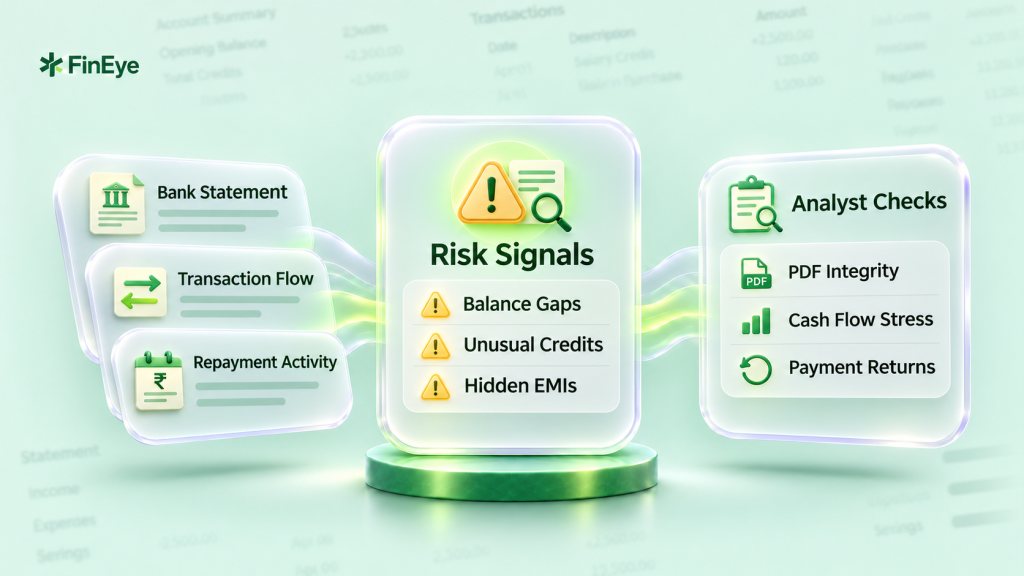
Using bank statements, GST returns and ITRs, the NBFC checks what the borrower really earns and spends, makes sure the documents tell the same story, and watches for red flags like bounces, hidden loans and fake statements.
Meena’s Example:
What the NBFC Checked
What It Found
Bank statements (12 months)
About ₹4 lakh a month coming in, mostly from customers
GST returns
₹45 lakh of sales a year, broadly matching bank credits
ITRs
Net profit of about ₹80,000 a month
Red flags
One EMI bounced eight months ago
Step 5: Repayment Capacity Check
The NBFC checks how much income is left after existing EMIs. It usesFOIR (the share of income going to EMIs) for salaried borrowers and DSCR (how many times earnings cover EMIs) for businesses.
Meena’s Example: Her monthly profit is about ₹80,000. With her ₹4,500 EMI plus about ₹36,000 for the new three-year loan, her total EMIs come to about ₹40,500. Her profit covers them about two times, a comfortable cushion.
Step 6: Policy Rules and Risk Grading
Every NBFC has a credit policy covering things like a minimum credit score, minimum years in business, a maximum FOIR and business types it avoids. Many NBFCs check these automatically with a rules engine, then give the borrower a risk grade that affects the rate and loan amount.
Meena’s Example: She passes every rule and is graded low-to-medium risk because of the one late EMI.
Step 7: Field Verification and Personal Discussion
For many business loans, an NBFC officer visits and talks to the borrower. This catches what paperwork can’t, like a shop that doesn’t exist.
Meena’s Example: Her shop is well-stocked, with two staff and steady customers. She explains that sales peak from October to February, which matches her bank statements.
Step 8: Collateral Check (for Secured Loans)
For secured loans, like a loan against property, the NBFC values the property, checks that the borrower legally owns it, and decides how much to lend against it (the Loan-to-Value).
Meena’s example: Her loan is unsecured, so this step doesn’t apply. For a loan against her shop, the NBFC would value it and check its title first.
Step 9: Credit Decision and Sanction
The underwriter sums up the findings in a short report, often called a credit appraisal memo, and recommends a decision: approve, approve with changes (like a lower amount or a co-applicant), or reject. Bigger loans or policy exceptions need a senior credit manager or committee. Once approved, the NBFC issues a sanction letter.
Meena’s Example: Her income is steady, her documents match and the late EMI was explained. Her ₹10 lakh loan is approved for three years.
Step 10: Key Fact Statement, Agreement and Disbursement
Before the agreement is signed, RBI requires the NBFC to give a Key Fact Statement (KFS): a simple summary of the loan amount, total yearly cost (APR), all fees and the repayment schedule. The borrower then signs, sets up automatic EMIs through e-NACH, and receives the money directly in their bank account.
Meena’s Example: Meena checks the total cost in her KFS, signs online and gets the money in time for the season.
Step 11: Monitoring After the Loan Is Given
NBFCs keep tracking EMI payments, credit report changes and, where agreed, bank account activity, so they can act early on warning signs.
Meena’s Example: Meena pays every EMI on time. A year later, her top-up loan for a second shop was approved much faster.
Traditional vs Digital Underwriting
Let us consider the difference between traditional and digital underwriting with the help of an example. Let us say Arjun, a salaried employee, applies for a ₹2 lakh personal loan on an NBFC’s app. He completes video KYC, shares bank data through anAccount Aggregator, and the app pulls his credit report. A rules engine checks everything against the NBFC’s policy, and he gets a decision in minutes and the money the same day. It’s the same steps as Meena’s, just faster and mostly automated.
Traditional Underwriting
Digital Underwriting
Best For
Larger, business and secured loans
Smaller personal loans
Documents
Physical copies or PDFs
Shared digitally
Credit Review
Mainly an underwriter
Mainly a rules engine
Field Visit
Common
Rare
Time to Decide
Days
Minutes to hours
RBI Rules That Shape Underwriting in 2026
NBFC underwriting isn’t only about the NBFC’s own policy. RBI rules also shape how it’s done. Here are a few that matter most today:
Key Fact Statement (KFS): Borrowers must receive a clear, standard summary of the loan, including the total cost, before signing the agreement.
Digital Lending Directions, 2025: These set rules for loans given through apps and digital platforms, including how NBFCs work with lending partners and how borrower data is protected.
NBFC Credit Facilities Directions, 2025: These bring RBI’s lending rules for NBFCs together in one place, covering areas like disclosures, cooling-off periods and digital lending.
Faster Credit Bureau Reporting: Lenders now report loan data to credit bureaus weekly, so credit reports reflect much more recent behaviour.
How FinEye Helps NBFCs Underwrite Better
Steps 4 and 5, checking income and repayment capacity, are where underwriters spend the most time. They’re also where most mistakes happen. FinEye helps NBFCs make these steps simpler and more reliable.
Read bank statements shared through Account Aggregator or as PDFs
Identify salary and business income
Pick up existing EMIs, including ones the borrower didn’t mention
Spot bounces, unusual credits and other red flags
Flag statements that may have been tampered with
For business borrowers like Meena, FinEye’s GST Analyser helps compare the sales a business reports in its GST returns with the money actually flowing through its bank account.
Conclusion
Credit underwriting is how an NBFC makes sure every loan is a sensible one. It’s a series of simple questions: Who is this borrower? What do they earn? What do they already owe? Can they afford one more EMI?
As Meena’s example shows, each step adds a piece to the picture, from KYC and the credit report to bank
statements, a shop visit and the final decision. And as Arjun’s example shows, the same steps can happen in minutes when they’re done digitally.
For NBFCs, getting these steps right means fewer bad loans and faster approvals for good borrowers. Tools like FinEye’s Bank Statement Analyser make the most time-consuming steps easier, so underwriters can focus on making the right call.





 November 16, 2026
 9 min read