How to Evaluate a Bank Statement Analyser: 15-Point RFP Checklist
shivam jadon
Featured
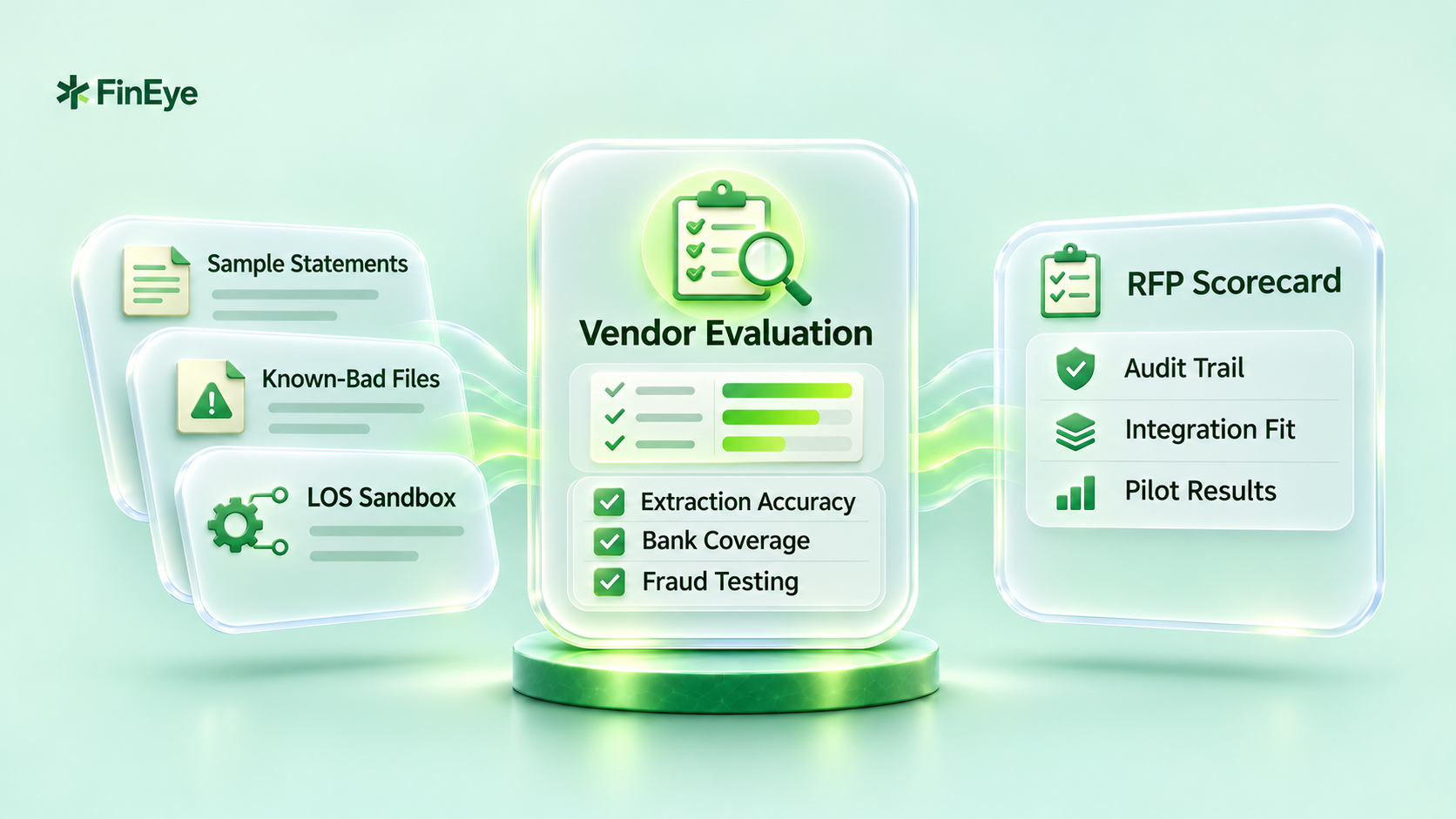
To evaluate a bank statement analyser, you should check five major areas: data coverage and accuracy, quality of analysis, speed and integration, security and compliance, and cost. Then test it on your own statements before you sign.
Most vendors look great in a demo. The real test is how the tool handles your borrowers, your banks and your volumes. In this blog, we will cover the 15-point checklist that helps you compare vendors fairly and ask the right questions in your Request for Proposal (RFP).
Key Takeaways
Judge a bank statement analyser on your own statements, not the vendor’s demo files.
Accuracy, fraud detection and coverage of smaller banks matter most for credit decisions.
Check speed and uptime at your real daily volume.
In India, check where data is stored, DPDP readiness and RBI outsourcing requirements.
Look closely at pricing models. Per-page pricing can cost far more than it seems.
What Does a Bank Statement Analyser Do?
A bank statement analyser reads a borrower’s bank statement, whether it’s a PDF or data shared through an Account Aggregator, and turns it into insights. It shows income, EMIs, bounces, cash flow and warning signs, so underwriters don’t have to go through every line by hand.
Why Choosing the Right One Matters?
Your analyser’s output feeds straight into credit decisions. If it gets something wrong, the loan decision is wrong too. For example, if a tool misreads a ₹1,00,000 salary credit as ₹10,000, the borrower’s income looks far lower, and they may be rejected. If it misses a hidden EMI, a risky borrower may be approved for too much.
Meet Kavya
To help you understand how to choose a bank statement analyser, we’ll use one example throughout this blog. Kavya is head of credit at a mid-sized NBFC that lends to small businesses in Tier 2 and Tier 3 towns. She has shortlisted three vendors, A, B and C, and wants to pick the right bank statement analyser. It is important to note that the numbers in her examples are illustrative.
How To Choose a Bank Statement Analyser: The 15-Point Checklist
Are you wondering how to choose a bank statement analyser? So let us cover the 15-point checklist to determine the quality of a bank statement analyser:
A. Data and Accuracy
1. Bank and Format Coverage
Your borrowers bank with big private banks, public sector banks, small finance banks and co-operative banks. They also share statements as scans, password-protected PDFs and phone photos. A good analyser should read all of them.
Kavya’s Test: She sends each vendor 200 real statements, including 30 from co-operative banks and 20 phone photos. Vendor A reads private bank statements perfectly but gets only 18 of the 30 co-op statements right. For her borrowers, that’s a big gap.
2. Accuracy of What It Reads
Every amount, date and description must be read correctly in the bank statement analysis software. A single wrong digit can change a borrower’s income andFOIR.
Kavya’s Test: Her team checks 50 statements by hand and compares them with each vendor’s output, line by line.
3. Account Aggregator and PDF Support
More borrowers now share data through Account Aggregators, but many still upload PDFs. You need one tool that handles both in the same way.
Kavya’s Test: She checks whether the same borrower’s AA data and PDF statement give the same results.
B. Analysis
4. Income Detection and Transaction Tagging
The analyser should identify salary and business income, and sort transactions into clear categories like rent, EMIs, utilities and cash.
Kavya’s Test: For a garment trader, Vendor B correctly separates customer UPI payments from a ₹2 lakh transfer from a relative. Vendor A counts both as business income.
5. EMI, Bounce and Obligation Detection
It should pick up every recurring EMI, including loans the borrower didn’t declare, along with bounces and penalty charges. The tool should be able to identify the red flags in a bank statement.
Kavya’s Test: In one statement, a ₹9,500 monthly debit to a small finance company isn’t in the application. Only two vendors flag it as an EMI.
6. Fraud and Tamper Detection
The tool should flag statements that have been edited or faked before they reach an underwriter.
Kavya’s Test: She hides 15 known tampered statements in her test set. Vendor B catches 13. Vendor C catches 6, but also flags 40 genuine statements, which would swamp her team with false alarms.
7. Clear, Explainable Results
A score alone isn’t enough. Underwriters need to see why something was flagged, in plain language they can act on.
Kavya’s Test: Vendor A shows a “high risk” label with no reason. Vendor B shows “Running balance mismatch on page 4, 12 March”. Her team prefers Vendor B.
C. Performance and Fit
8. Speed and Uptime at Real Volume
A tool that’s fast in a demo can slow down when thousands of statements arrive at once. Ask for speed and uptime numbers at your expected volume.
Kavya’s Test: Vendor C returns results in 20 seconds in the demo. At 5,000 statements a day in the pilot, it takes about 4 minutes each.
9. Integration With Your Loan System
Results should flow straight into your loan origination system through an API, without anyone copying data by hand.
Kavya’s Test: She asks each vendor for API documentation and how long integration usually takes. Vendor B shares sample outputs her tech team can review on day one.
10. Customisable Rules and Thresholds
Every lender has its own credit policy. You should be able to set your own rules, like what counts as a large unexplained credit, instead of accepting fixed settings.
Kavya’s Test: For her small business borrowers, she wants cash deposits above a certain share of income flagged. Only two vendors let her set this herself.
D. Security and Compliance
11. Data Stored in India
Under RBI’s digital lending rules, borrower data must be stored on servers in India. If it’s processed abroad, it has to come back within 24 hours.
Kavya’s Test: She asks each vendor, in writing, where data is stored and processed, including by any sub-contractors.
12. Security and Access Controls
Bank statements hold very sensitive data. Check how the vendor protects it, who can access it, and how access is logged.
Kavya’s Test: She asks for the vendor’s security policies and the results of recent independent security audits.
13. DPDP Readiness
Under the Digital Personal Data Protection (DPDP) Act, your NBFC is usually the “data fiduciary”, and the vendor is the “data processor”. The main obligations, including breach notices and penalties, are expected to apply from May 2027. The vendor must support consent, data retention limits, deletion on request and quick breach alerts.
Kavya’s Test: She asks how long the vendor keeps statements after analysis, and how quickly it can delete a borrower’s data on request.
14. RBI Outsourcing Readiness
RBI’s Outsourcing Directions, 2025 ask many NBFCs to keep checking their IT vendors, give RBI and auditors access to relevant data, keep track of sub-contractors and have an exit plan.
Kavya’s Test: She checks whether each contract allows audits, lists sub-contractors, and explains how her data will be returned if she switches vendors.
E. Commercials
15. Pricing, Support and Pilot Terms
Pricing models vary: per statement, per page or a monthly fee. Compare them using your real statements. Also check support hours and whether the vendor offers a paid or free pilot.
Kavya’s Test: Vendor A’s per-page price looks cheapest. But her borrowers’ 12-month statements average 40 pages, which makes it the most expensive option.
Sample Questions on How to Choose a Bank Statement Analyser
If you are still wondering how to choose a bank statement analyser, you can use these questions in your Request for Proposal (RFP). The answers to the following RFP checklist tell you a lot about each vendor:
Question to Ask
A Good Answer
A Red Flag
Which banks and formats do you support?
A full list, including co-op banks and scans
“All banks” with no list
How do you measure accuracy?
A clear method you can repeat in a pilot
A single number with no method
Do you support AA data and PDFs?
Yes, with the same output for both
Only one of the two
How do you identify income?
Explains how it separates income from transfers
“Our AI handles it”
Do you detect undeclared EMIs?
Shows sample outputs with recurring debits flagged
No examples
How do you detect tampered statements?
Explains its checks and how often they’re updated
No detail, or no fraud checks at all
What does a flagged result show?
The reason, in plain language
A score with no explanation
What’s your speed and uptime at our volume?
Figures at production volume
Only demo numbers
How long does integration take?
A realistic timeline and API documentation
No documentation before signing
Can we set our own rules?
Yes, without custom development
Fixed settings only
Where is data stored and processed?
In India, confirmed in writing
Unclear or “in the cloud”
How do you protect and log access to data?
Clear policies and recent audit results
Vague answers
How do you support DPDP needs?
Clear retention, deletion and breach processes
“We’ll handle it later”
Do you allow audits and list sub-contractors?
Yes, written into the contract
Refuses audit access
How is pricing calculated?
Clear examples using your statements
Hidden or unclear charges
How to Run a Pilot?
Never choose a bank statement analyser on a demo alone. Run a short pilot in four steps:
Pick Real Statements: Use a mix that matches your borrowers, including smaller banks, scans and phone photos.
Add Known Problem Files: Include a few tampered statements and statements with hidden EMIs.
Measure the Results: Track accuracy, fraud caught, false alarms and speed.
Compare with Manual Review: Have your team check a sample by hand and compare.
Common Mistakes to Avoid When Choosing a Bank Statement Analyser
Most lenders don’t pick the wrong vendor because they skipped research. They pick the wrong one because they tested the wrong things. Here are the mistakes that cause the most trouble later.
Judging the Tool on the Vendor’s Demo
Demo files are usually clean, digital statements from large banks. Your borrowers’ statements won’t all look like that.
Testing Only Easy Statements
If your test set only has statements from big private banks, every vendor will look good. The differences show up on co-operative bank statements, scanned copies and statements with odd layouts.
Comparing Headline Prices Instead of Real Costs
A low price per page can turn into the most expensive option once you count how many pages your borrowers’ statements actually have.
Ignoring False Alarms
A tool that flags too many genuine statements as risky creates extra work. Your team spends hours checking files that were fine, and good borrowers wait longer for a decision.
Leaving the Credit Team Out of the Evaluation
When only the tech or procurement team evaluates vendors, they often focus on integration and price. But underwriters are the ones who use the output every day.
Checking Compliance At the Very End
Data storage, DPDP readiness and audit rights should be checked early. If a vendor fails these checks after a long pilot, all that time is wasted.
Conclusion
Choosing a bank statement analyser is more than just a technology decision. It’s a credit decision, because the tool’s output shapes every loan you approve or reject.
If you’re starting your own evaluation, here’s a simple way to begin:
Shortlist two or three vendors that support both Account Aggregator data and PDFs.
Send them the 15 RFP questions above and compare their written answers.
Run a pilot on a few hundred of your own statements, including known problem files.
Score each vendor using weights that match your borrowers and your risk priorities.
Check compliance and the contract before you sign, not after.
Put FinEye Through the Checklist
The best way to judge any bank statement analyser, including ours, is to test it on your own statements. FinEye’s Bank Statement Analyser is built for Indian lenders. In a pilot, you can check how it:
Reads statements shared through Account Aggregator as well as PDF uploads
Identifies salary and business income
Picks up recurring EMIs, including ones the borrower didn’t declare
Flags bounces, unusual credits and other red flags
Flags statements that may have been tampered with
For business borrowers, you can also test FinEye’s GST Analyseralongside it to compare reported sales with actual bank credits. Bring your toughest statements, use the checklist in this blog, and see how FinEye performs against your own standards. Contact us now!
Frequently Asked Questions
What is a bank statement analyser?
A bank statement analyser is software that reads a borrower’s bank statement and turns it into useful insights. It identifies income, EMIs, bounces, cash flow patterns and warning signs, so underwriters don’t have to go through every transaction by hand. Most tools work with PDF statements, and many also work with data shared through Account Aggregators.
What should an RFP for a bank statement analyser include?
A good RFP should cover five areas: data coverage and accuracy, quality of analysis (including fraud detection), speed and integration, security and compliance, and pricing. It should also ask for sample outputs, API documentation and pilot terms.
How do I test a bank statement analyser’s accuracy?
Pick a sample of your own statements, say 50, and have your team record the key details by hand: transaction amounts, dates, total monthly income and EMIs. Then compare these with the tool’s output. Check both line-level accuracy and whether the final figures, like average monthly income, match. A tool can read most lines correctly and still get the totals wrong.
What accuracy should I expect from a bank statement analyser?
There’s no single standard number, and vendors measure accuracy in different ways. Instead of relying on a vendor’s headline figure, ask how they measure it, then test it yourself in a pilot. Pay extra attention to the banks and formats your borrowers use most.
What’s the difference between a bank statement analyser and an Account Aggregator?
An Account Aggregator moves the borrower’s bank data from the bank to the lender, with the borrower’s consent. A bank statement analyser reads that data, or a PDF statement, and turns it into insights for credit decisions. Most lenders need both: the AA to get the data, and the analyser to make sense of it.
Can a bank statement analyser detect fake bank statements?
Some can, but not all. Tamper detection only applies to PDFs and images the borrower uploads, because that’s where edits can happen. Data shared through an Account Aggregator comes straight from the bank, so it can’t be edited along the way. Ask each vendor what checks they run and test them with known tampered files in your pilot.
Does bank statement data need to be stored in India?
For digital lending, RBI requires borrower data to be stored on servers in India. If any processing happens abroad, the data must come back to India within 24 hours. Confirm in writing where each vendor, and any of its sub-contractors, stores and processes your data.
Who should be involved in evaluating a bank statement analyser?
Involve your credit or risk team, your tech team, your compliance team and procurement. Credit teams judge whether the output is useful, tech teams check integration, compliance checks data storage, DPDP and RBI requirements, and procurement handles pricing and contract terms.
Do RBI’s outsourcing rules apply when using a bank statement analyser?
RBI’s Outsourcing Directions, 2025 set out how NBFCs should manage risk when they use outside service providers. The IT outsourcing chapter applies to NBFCs in the middle layer and above. Even if your NBFC isn’t covered, the same practices, like audit rights, subcontractor lists and an exit plan, are worth building into your contract. Check the details with your compliance team.





 November 18, 2026
 13 min read