







Menu
A small steel trader applies for a ₹50 lakh working capital loan. There are no audited financials, just 12 months of GST returns uploaded as PDFs. The turnover looks healthy. But is it real? And what do those returns actually say about the business?
This is the question a GST analyser answers for lenders.
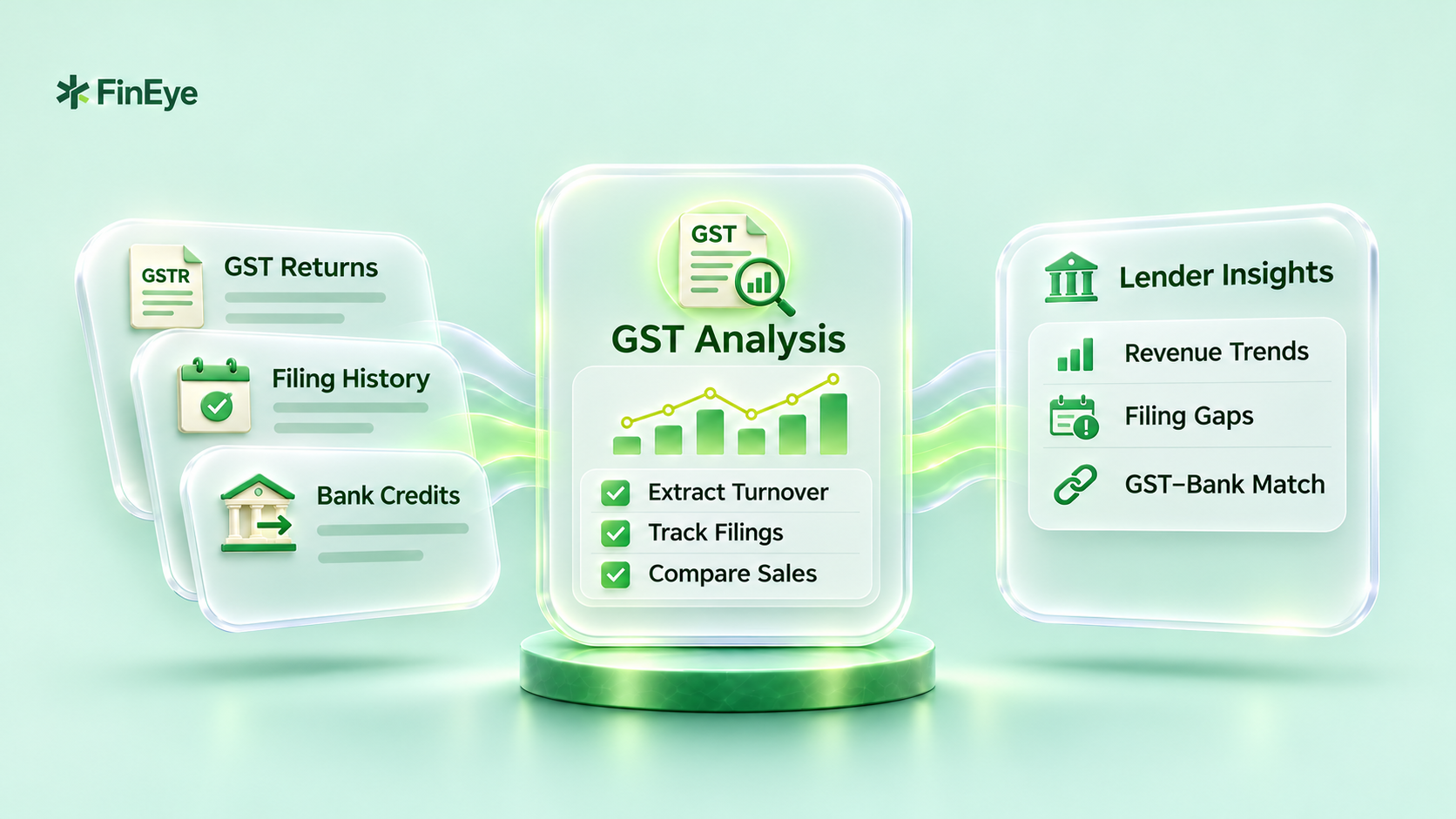
A GST analyser is a tool lenders use to check whether a borrower’s GST returns are genuine and to turn them into a detailed credit report. It verifies the returns against GST records, flags tampering and mismatches, and shows turnover, filing discipline, buyers, suppliers and tax behaviour in one place.
Let us cover how a GST analyser works, which GST returns it reads, how it catches tampered returns, and what a GST analysis report tells an underwriter.
A GST analyser is software that reads a borrower’s GST returns, confirms they are genuine, and turns raw return data into insights a credit team can use.
Think of it as a credit analyst that never gets tired of GST forms. Instead of an underwriter opening 24 PDFs, typing figures into a spreadsheet and hoping nothing was edited, the GST analyser does three jobs at once:
Let us consider a textile wholesaler that shares 12 months of GSTR-3B. The GST analyser confirms each return was filed on the GST portal, shows turnover of ₹1.8 crore with a festive-season peak in October, and flags that two months were filed 40 days late. The underwriter sees all of this on one screen.
The term “GST analysis” is used for three very different things. Here’s how they differ:
| Tool | Who Uses It | What It’s For |
| GST Analyser (for Lenders) | Banks, NBFCs, fintech lenders | Verifying a borrower’s GST returns and assessing creditworthiness |
| GST Compliance Tool | Businesses and their CAs | Filing returns, reconciling ITC, avoiding notices |
| Government GST Analytics | GST department | Detecting tax evasion and fake invoicing across taxpayers |
Many MSMEs don’t have audited balance sheets, or have them only once a year. But almost every registered business files GST returns every month or quarter. That makes GST data one of the most frequent and structured records of how a business is actually doing.
This is the idea behind GST-based lending: assess a business through its tax filings rather than relying only on annual financials.
GST analysis for loans helps lenders answer questions like:
Let’s understand this with the help of an example. A kirana distributor in Indore has no audited financials for the current year. But 24 months of GSTR-3B show steady turnover of about ₹8 lakh a month, filed on time. That gives the lender a reliable base to size a credit line, which a thin balance sheet couldn’t.
A GST analyser mainly reads five returns. Each one answers a different credit question.
| Return | What It Contains | Credit Question It Answers |
| GSTR-1 | Invoice-level details of outward supplies (sales), with buyer GSTINs for B2B sales | Who are the buyers, and how concentrated are sales? |
| GSTR-1A | Amendments to GSTR-1 made before GSTR-3B is filed | Were sales figures corrected, and by how much? |
| GSTR-3B | Monthly or quarterly summary of sales, tax payable, ITC claimed, and tax paid | What is the declared turnover, and is tax paid on time? |
| GSTR-2B | Auto-generated statement of ITC available from suppliers’ filings | Are the business’s purchases real, and is the ITC claimed reasonable? |
| GSTR-9 | Annual return that sums up the year | Do the yearly numbers match the monthly returns? |
GSTR analysis also starts with the GSTIN itself. A GSTIN is 15 characters long, and characters 3 to 12 are the business’s PAN. So a GST analyser can link every GSTIN a business holds back to one PAN, and spot returns that belong to a different entity.
Tip: Businesses with turnover up to ₹5 crore can file quarterly under the QRMP scheme. A good GST analyser reads a quarterly return as covering three months, so it doesn’t flag false gaps in filing.
A GST analyser follows six steps, from collecting the returns to producing the GST analysis report:
Lenders usually get GST data in one of three ways:
Data fetched from the source is very hard to fake, because it never passes through the borrower’s hands. Uploaded PDFs are different. They can be edited, borrowed from another business or made from scratch.
In practice, lenders see both. Some borrowers won’t complete an AA or OTP flow, and some lending journeys still accept documents. That’s why a good GST analyser works with both: it reads source data directly and runs tampering checks on every uploaded file.
Both paths end in the same GST analysis report. The difference is that uploaded PDFs must pass tampering checks first.
Two recent GST changes make GST analysis sharper for lenders:
A GST return PDF is easy to edit and hard to check by eye. A changed number looks exactly like a real one. This is where a GST analyser does its most important work.
The first four are document fraud. The last two involve real filings, so they’re caught by analysis rather than document checks. A good GST analyser looks for both.
A GST analysis report puts everything an underwriter needs from GST data on one page. Here are the sections it usually covers, and why each one matters:
| Report Section | What It Shows | Why It Matters |
| Business Profile | GSTINs, PAN-level view, registration status, business type | Confirms the borrower is real and links all its GSTINs |
| Turnover Trend | Monthly and yearly sales, growth, seasonality | Shows the size of the business and whether it’s growing |
| Filing Discipline | On-time vs late filings, gaps, nil returns | A proxy for how disciplined the business is |
| GSTR-1 vs GSTR-3B | Differences between reported sales and declared liability | Flags underreporting or edited figures |
| ITC Pattern | ITC claimed vs ITC available in GSTR-2B | Flags excess or suspicious credit claims |
| Buyer and Supplier Concentration | Top customers and suppliers by share of business | Shows dependence on a few parties and related-party risk |
| GST vs bank Credits | GST turnover against money actually received | Confirms declared sales turned into real cash |
| Red-flag Summary | All warning signs in one list | Lets the underwriter decide quickly |
Say a packaging manufacturer in Ahmedabad applies for a ₹30 lakh term loan. Here’s how an underwriter might read its GST analysis report:
The above reports demonstrate that the packaging manufacturer is a sound borrower with one concentration risk. The underwriter can approve, perhaps with a covenant or closer monitoring of the top buyer.
Any lender that funds businesses can use a GST analysis tool. The way they use it changes with the product:
Not every GST analyser does the same job. Use this checklist when you compare options:
FinEye is an Account Aggregator technology service provider that serves every type of lender, from banks and NBFCs to fintechs. The FinEye GST Analyser works with both kinds of GST data. It reads returns fetched from the source through Account Aggregator, and it checks GST return PDFs uploaded by borrowers for tampering. Either way, underwriters get one detailed GST analysis report with almost everything they need to assess a business.
Pair it with the FinEye Bank Statement Analyser to match declared GST turnover with actual bank credits in the same dashboard, as part of FinEye’s growing set of financial document analysers.
Want to see it on your own borrower files? Book a demo of FinEye’s GST Analyser.
Yes, when they’re shared as PDFs. Figures can be edited, unfiled returns can be shown as filed, and another business’s returns can be renamed. A GST analyser catches these through source matching, GSTIN and PAN checks, filing record checks, PDF forensics and arithmetic checks.
GST data fetched through Account Aggregator comes directly from GSTN with the borrower’s consent, so the borrower can’t edit it. It can still contain real but inflated sales, such as circular trading. That’s why GST analysis still matters even with source data.
Most lenders look at 12 to 24 months of GST returns. Twelve months show the current scale and seasonality; 24 months show the growth trend.
Yes. A good GST analyser reads a quarterly return as covering three months, so a quarterly filer isn’t wrongly flagged for missing months.
A business registered in more than one state has a GSTIN for each state, all linked to the same PAN. A GST analyser combines them into a PAN-level view so the lender sees total turnover across all GSTINs.
No. GST analysis is a strong input, but lenders should combine it with bank statement analysis, credit bureau reports and their own policy checks before approving a loan.
The biggest red flags are a large gap between GSTR-1 and GSTR-3B, GST turnover much higher than bank credits, frequent late or bunched filings, high dependence on one buyer, and buyers or suppliers with cancelled GSTINs.

Content strategist and SEO writer with 2+ years of experience creating high-performing, brand-aligned content for leading insurance and financial services companies. Skilled in translating complex financial-related concepts into engaging, SE0-optimized content that drives organic traffic, brand awareness, and lead generation. Adept at leveraging AI tools for content optimization while maintaining brand voice and editorial quality.


 Uncategorized
November 23, 2026
Choosing a bank statement analyser used to be simple: find a tool that reads PDFs. Not anymore. Today, Indian lenders get statements…


 Featured
November 23, 2026
Consider a credit analyst at an NBFC on a Monday morning. On her desk is one MSME loan file with six months…
 Featured
November 18, 2026
To evaluate a bank statement analyser, you should check five major areas: data coverage and accuracy, quality of analysis, speed and integration,…
