Best Bank Statement Analysis Software for Lenders in India (2026)
Jibran SuhailContent strategist and SEO writer with 2+ years of experience creating high-performing, brand-aligned content for leading insurance and financial services companies. Skilled in translating complex financial-related concepts into engaging, SE0-optimized content that drives organic traffic, brand awareness, and lead generation. Adept at leveraging AI tools for content optimization while maintaining brand voice and editorial quality.
Uncategorized
Choosing a bank statement analyser used to be simple: find a tool that reads PDFs. Not anymore. Today, Indian lenders get statements as PDFs, scanned copies and Account Aggregator (AA) data, often all for the same borrower. The best bank statement analysis software is the one that handles all of this without making your credit team juggle tools.
The best bank statement analysis software for lenders in India in 2026 includes FinEye, Perfios, FinBox BankConnect, HyperVerge, Signzy, Novel Patterns, Precisa and Finezza. For most lending teams that receive both AA data and PDF statements, FinEye is the strongest fit because it brings both into one dashboard and one review workflow, with tamper flags on PDF files.
Key Takeaways
Indian lenders now receive bank statements through two routes, PDF uploads and Account Aggregator data, so the best bank statement analyser should handle both well.
FinEye stands out for lending teams that want AA and PDF statements reviewed in one dashboard and one workflow, with tamper flags on PDFs.
Perfios, FinBox, HyperVerge and Signzy are strong options for specific needs, such as large document suites, in-app journeys, combined KYC or API-first setups.
Novel Patterns suits lenders who also want monitoring after disbursal, while Precisa and Finezza suit smaller teams or those focused on format coverage.
Always test any bank statement analysis tool on your own messiest statements before you sign up.
Best Bank Statement Analysis Software in India: At a Glance
Here is the list of the best bank statement analysis software available in India:
Tool
Best For
Data Sources
Fraud and Tamper Checks
How You Use It
FinEye
Lending teams that want AA and PDF statements in one dashboard and one workflow
AA + PDF, reviewed together
Tamper flags on PDF files
Dashboard
Perfios
Large banks that want a broad document analysis suite
ePDF, scanned copies, internet banking; AA across its suite
Built-in fraud control unit (FCU) checks
Platform and APIs
FinBox BankConnect
Digital lenders building statement collection into their own app
AA + PDF
Fraud detection built into reports
SDK, API, dashboard
HyperVerge
Lenders that want KYC and statement analysis from one vendor
PDF, scans, e-statements, AA
Tampering and anomaly flags
Platform and API
Signzy
Tech teams integrating through APIs
PDF, net banking, AA
Part of its analysis
API
Novel Patterns (CART)
Lenders that also want monitoring after the loan is given
eStatements, scanned statements, passbooks
Circularity and anomaly detection
Platform
Precisa
Small lenders, CAs and pay-per-use buyers
Uploads + AA connector
Suspicious transactions and tampering
Web portal
Finezza
NBFCs that want wide bank format coverage
Bank statements across many formats
Part of its analysis
Cloud platform
How We Chose These Bank Statement Analysis Tools
We focused only on bank statement analysis tools that serve lenders in India. Each one was assessed on what matters most to a credit team’s daily work:
Data Sources: Can it handle both PDF statements and Account Aggregator data, and can your team review them together?
Tamper Detection: Does it flag edited or suspicious PDF statements before they reach underwriting?
Ease of Use for Credit Teams: Can analysts work in it directly, or does it need heavy tech integration first?
Reliability: Is the platform stable enough to sit in the middle of your loan process?
Indian Context: Does it understand Indian banks, transaction types like UPI and NEFT, and the AA framework?
1. FinEye
FinEye is one of the leading bank statement analysis software for banks, NBFCs, fintechs and MSME lenders whose borrowers share statements both through Account Aggregator and as PDFs.
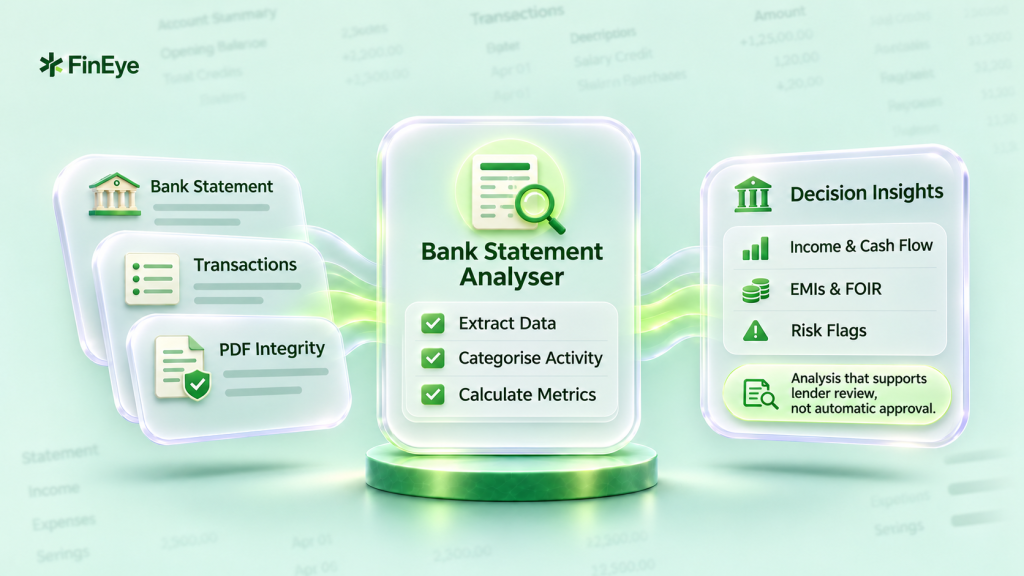
FinEye’s Bank Statement Analyser is an AI-driven bank statement analyser built around the idea that your credit team should review every statement in one place, however it arrives.
Here’s why that matters. Say an MSME borrower holds a current account at a large private bank and a second account at a local cooperative bank. The private bank is on the AA network, so the borrower shares that data through consent. The cooperative bank isn’t, so they upload a PDF. With many tools, your analyst ends up reviewing these in separate flows and joining the picture together by hand. With FinEye, both sit in the same dashboard and go through the same review workflow, so the analyst sees the borrower’s full banking picture in one go.
Key Features
One Dashboard, one Workflow: AA data and PDF statements are reviewed side by side, with no switching between tools or merging reports by hand.
Built by an AA Technology Service Provider: FinEye is an Account Aggregator TSP, so AA-based data collection is a core part of the product, not an add-on.
Tamper Flags on PDFs: Edited or suspicious PDF statements are flagged, so analysts know exactly which files need a closer look.
Clear Cash Flow View: Income, expenses, EMIs, bounces and balances, laid out for quick credit decisions.
99.99% Platform Uptime: Built to run reliably in the middle of your loan process.
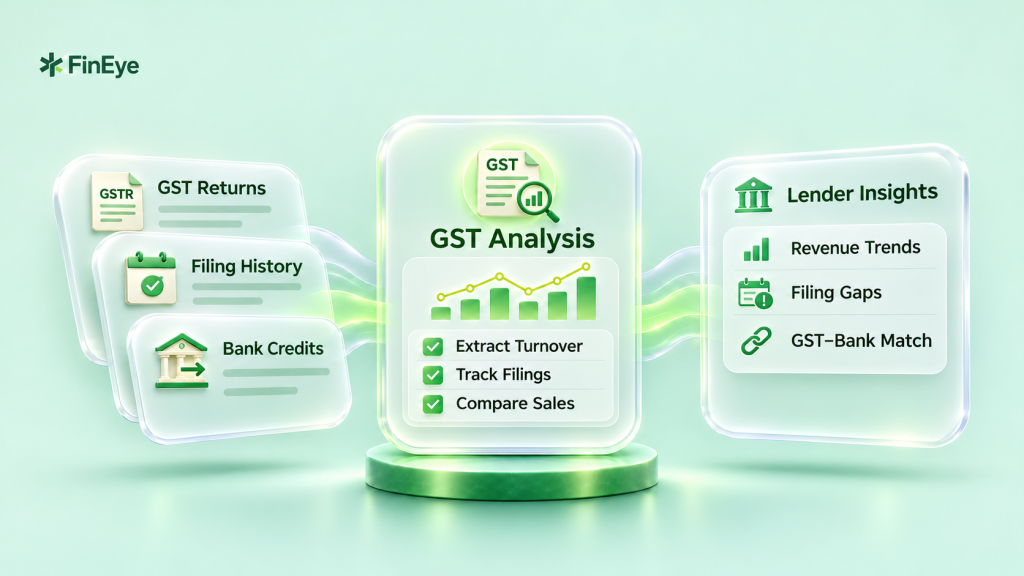
Works with the GST Analyser: Pair it with FinEye’s GST Analyser to compare what a business reports with what moves through its bank account. More document analysers are on the way.
Who It’s Built For
FinEye works for every type of lender, from banks and NBFCs to fintechs and MSME-focused lenders. Teams use it directly through the FinEye dashboard, so credit analysts can start reviewing statements without waiting on a long tech integration.
2. Perfios
Perfios is a good option for large banks and NBFCs that want bank statement analysis as part of a wider set of document analysers.
Perfios is one of the longest-running names in Indian financial data analysis. Its website describes it as trusted by over 1,000 institutions. Its Bank Statement Analyser fetches statements through ePDF upload, scanned documents and internet banking, then analyses transactions and creates a report for credit managers.
Built-in fraud control unit (FCU) checks for unauthorised ePDF changes and suspicious transactions
Part of a wider suite that also covers financial statements, IT returns, payslips and GST, with AA data across its document analysers
Suited to large institutions with established processes
3. FinBox BankConnect
It is a good option for fintechs and digital lending platforms that want borrowers to share statements inside their own app.
FinBox BankConnect lets borrowers submit bank statements in a lender’s app, then processes them and shares enriched data with the lender. It is Account Aggregator-enabled and also accepts PDF statements.
An SDK that lets lenders customise the borrower’s journey
Reports with month-wise credits and debits, daily balances and bounced transactions
Fraud detection built into the analysis
It is worth noting that BankConnect shines when you’re building the borrower journey into your own product. Teams that mainly want a ready-to-use review dashboard for analysts should check how much setup their workflow needs.
4. HyperVerge
HyperVerge is the emerging option for lenders that want identity verification and bank statement analysis from the same vendor. HyperVerge offers bank statement analysis as part of a wider onboarding and verification platform. Its statement analysis accepts PDFs, scans, e-statements and AA feeds, and sits alongside its KYC and document checks.
Income, cash flow and EMI insights
Tampering and anomaly flags
One vendor for onboarding and statement analysis
5. Signzy
This bank analysis software is a good option for lenders with in-house tech teams that want to plug statement analysis into their systems through an API.
Signzy’s Bank Statement Analysis API accepts PDF statements and can also fetch statements from the borrower’s bank through net banking or the Account Aggregator API. It says it can switch automatically between AA and manual upload.
Average response time of under 3 seconds, according to Signzy
Consolidated analysis across multiple bank statements
Go-live in 2–4 weeks, as stated on its website
You should note that Signzy is built as an API product, so you’ll need tech resources to set it up and build the screens your analysts use.
6. Novel Patterns (CART)
This suits lenders that want to keep watching borrower accounts after the loan is given. Novel Patterns’ CART turns bank statements into underwriting insights, covering cash flows, risk patterns and fraud indicators. The company says CART has analysed more than 600 million transactions. It also offers HawkEye, a tool for monitoring borrower health after disbursal.
Works with eStatements, scanned statements and passbooks
Flags circular transactions, suspicious money flows and statement manipulation
Post-disbursal cash flow monitoring through HawkEye
CART is part of a wider credit decisioning platform. It suits lenders looking for an end-to-end setup more than those wanting a focused statement review tool.
7. Precisa
Precisa is a good option for small NBFCs, CAs and teams that analyse a modest number of statements and want flexible pricing. It is a cloud-based tool that analyses bank statements, GST returns, credit reports and IT returns. Its listings mention a pay-per-use plan starting at ₹100 and support for more than 850 banks, according to the vendor.
Upload statements or fetch data through an AA connector
Multi-account analysis and counterparty detection
Flags suspicious transactions and possible tampering
8. Finezza
This bank statement analysis tool is suited to NBFCs that deal with statements from many different banks and formats. Finezza offers a cloud-based bank statement analyser for banks, NBFCs, wealth managers and insurers. Its website lists support for more than 450 banks and over 1,000 bank statement formats.
Wide coverage of bank formats
Transaction categorisation and cash flow analysis
Supports statements from banks across 8 countries, according to its website
How to Choose the Best Bank Statement Analyser for Your Team
The best bank statement analyser for you depends on how your team works. Ask these five questions:
How do your borrowers share statements? If you get a mix of AA data and PDFs, pick a tool that lets analysts review both in one place. Otherwise, your team ends up stitching reports together by hand.
Who will use it every day? If credit analysts will work in the tool directly, a ready-to-use dashboard matters more than an API.
How worried are you about edited statements? For PDF-heavy flows, tamper flags with clear reasons are a must.
How reliable does it need to be? If the tool sits in the middle of your loan process, downtime means stuck applications. Ask for uptime figures.
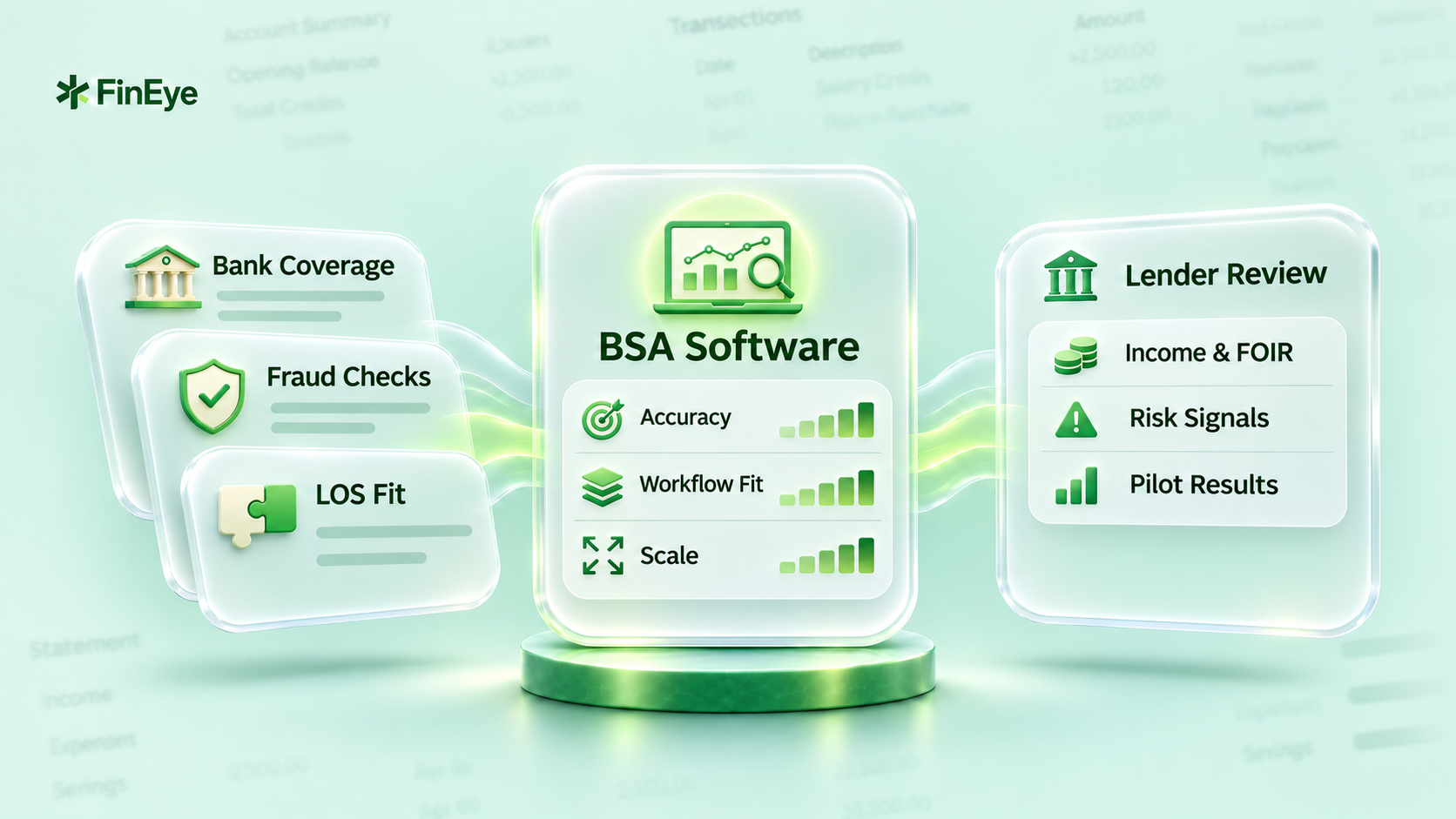
Does it fit your other checks? Statement analysis works best alongside GST, ITR and credit bureau data, so check what else the vendor offers.
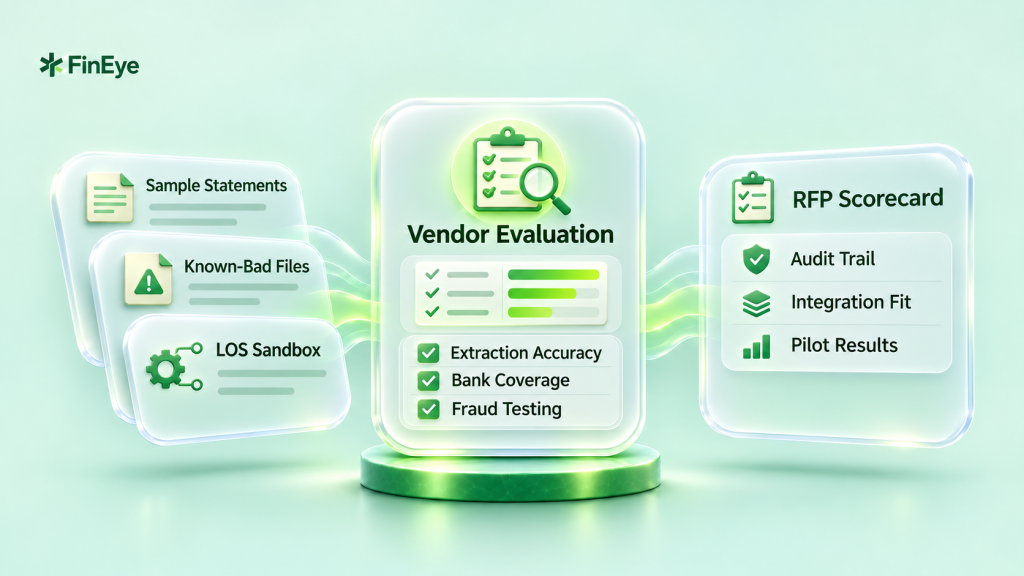
Before you sign, run a trial on 50–100 of your own statements, including scanned copies, password-protected PDFs and cooperative bank formats.
Every tool on this list can read a bank statement. What separates them is how well they fit the way your team actually works. Some are built for large document suites, some for in-app journeys and some for API-first setups.
If your borrowers share statements both through Account Aggregator and as PDFs, and you want your credit team reviewing everything in one place, FinEye is built for exactly that. One dashboard, one workflow, with tamper flags on PDFs and 99.99% uptime behind it. See FinEye’s Bank Statement Analyser in action.
Frequently Asked Questions
Which is the best bank statement analyser in India?
It depends on your workflow. For lending teams that receive both Account Aggregator data and PDF statements, FinEye is a strong choice because it brings both into one dashboard and one review workflow. Perfios suits large banks wanting a broad document suite, while FinBox BankConnect suits lenders building in-app borrower journeys.
Which bank statement analysis tools support both Account Aggregator and PDF statements?
FinEye, FinBox BankConnect, HyperVerge, Signzy and Precisa all support both routes. The difference is how they bring the two together. FinEye, for example, lets analysts review AA and PDF data side by side in the same dashboard.
Is there a free bank statement analyser?
Some tools offer free trials or low-cost pay-per-use plans, such as Precisa. Most bank statement analysis software built for lenders is paid and priced on volume. Vendors like FinEye offer a demo so you can test it first.
Can bank statement analysis tools detect fake statements?
Yes. Most tools on this list flag signs of tampering in PDF statements, such as edited file data, font mismatches or balances that don’t add up. Account Aggregator data comes directly from the bank, so it carries much lower tampering risk.
What is the difference between a bank statement analyser and an OCR tool?
An OCR tool only reads the text and numbers from a statement. A bank statement analyser goes further: it categorises transactions, works out income and EMIs, and flags risks for a credit decision.
What should NBFCs look for in bank statement analysis software?
NBFCs should look for support for both AA and PDF statements, tamper detection, coverage of smaller and cooperative banks, an easy dashboard for analysts and strong platform uptime.
Jibran Suhail
Content strategist and SEO writer with 2+ years of experience creating high-performing, brand-aligned content for leading insurance and financial services companies. Skilled in translating complex financial-related concepts into engaging, SE0-optimized content that drives organic traffic, brand awareness, and lead generation. Adept at leveraging AI tools for content optimization while maintaining brand voice and editorial quality.





 November 23, 2026
 11 min read